

This month, the Koren publishing house released a new graphic novel. The book illustrates the first 11 chapters of the Book of Genesis.
The book’s publication is a big deal. Over the last few years, Koren has invested heavily in illustrated versions of classic Jewish texts. There’s an illustrated Haggadah for Passover, an illustrated Book of Jonah for Yom Kippur, and an illustrated Book of Esther for Purim. There are even illustrated editions of parts of the Mishnah.
Though this new publication is only the first installment, it signals something big. When fully completed, Koren will have produced a fully illustrated ḥumash (Pentateuch) that sits within Jewish interpretive tradition. That is the sort of project that can reshape a community’s relationship to the text—especially when it is designed for kids, as this one seems to be.
This is a very good thing. As I argued in one of my first posts here, there is no reason that Jewish ideas should be restricted to text. The next thousand years of Jewish history will undoubtedly see an explosion of non-textual Torah. This conviction was a major reason that I started Print-O-Craft Press, and I’m proud of the graphical content it has supported.
But there are graphics and there are graphics. Sometimes illustrations simply serve as a visual aid for kids who have grown up around such an embarrassment of amazing graphic novels (my family loves Mexikid and El Deafo) that pictures are simply the price of attention.
Some illustrated versions of the Bible are like this. I won’t name them here. There’s nothing wrong with phoning it in, of course, but it’s also clear that these editions aren’t trying to say anything (at least, not on purpose).
Koren, on the other hand, has always taken its illustrations quite seriously. Their graphics team, led by Gorf (a former DC Comics editor) and Yael Nathan, has always been attempting to do something more complex. Their haggadah, for example, has a goat as a protagonist, recalling both the closing Had Gadya song and the Passover sacrifice itself. It also contains a few Nazis, in homage to how the seder collapses Jewish history into cycles of persecution and redemption. It has an opinion on the underlying text.
This is important, because it means that Koren’s illustrated editions function as a visual peirush (commentary), and they deserve to join the ranks of the centuries of commentators that came before them.
But what kind of commentary? In my review of Koren’s Book of Esther, I wrote:
Gorfinkel and Nathan’s work is something like Rashbam inflected with bits of Rashi. Rashbam’s commentary is famous for its brevity and commitment to the plain meaning of the text, to pshat. Rashi, meanwhile, felt much more comfortable drawing in rabbinic source material, so that the reader might see the Bible as the rabbis saw it. In addition, his experience with the Crusades led him to view the source text through the lens of Jewish persecution. This graphic novel’s commitments are clearly to the plain meaning of the text, but it interrupts this occasionally to offer an idea that goes beyond it, especially those ideas that involve Jewish vulnerability.
Rashi, of course, is by far the most popular Bible commentator of all time, and Rashbam’s concision is rarely controversial. Illustrating in this style is about as safe as you can get.
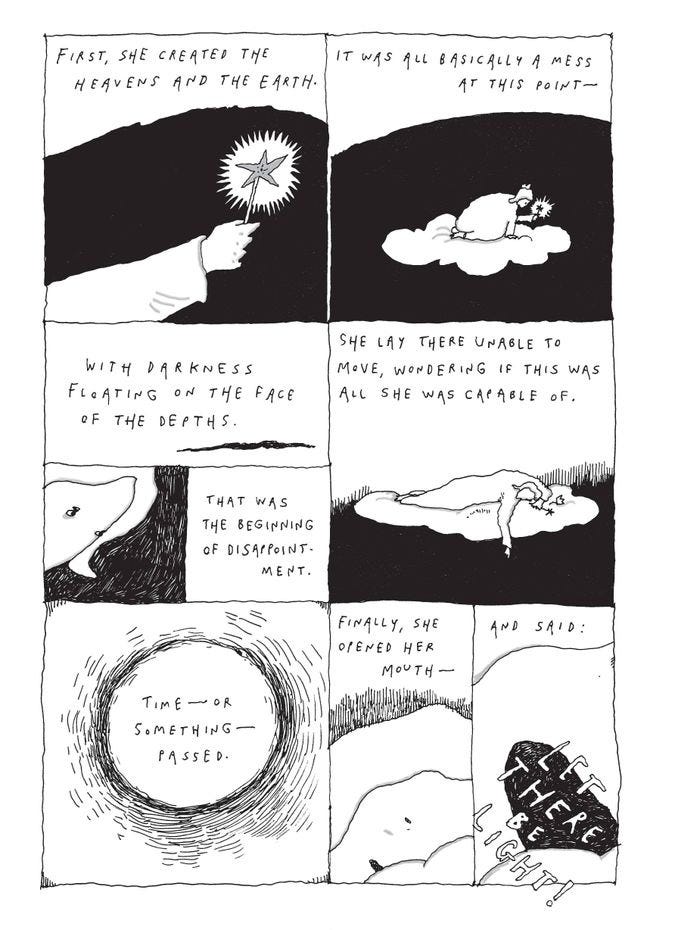
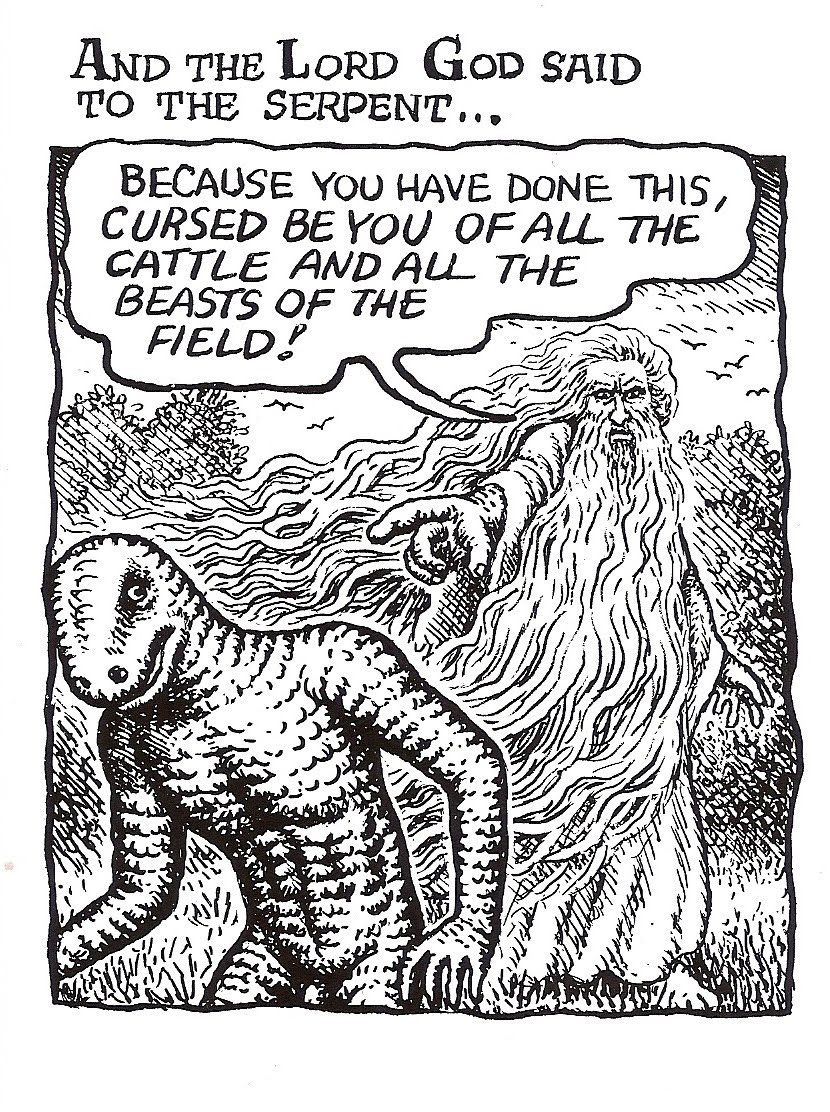
This isn’t the only way to do it. R. Crumb and (more recently) Liana Finck have shown that you can do a lot of very weird things when you take liberties with the Bible.
Koren can’t really do that; its first obligation is to textual fidelity. So, as Koren ships the first brick in its new ḥumash, we should ask: What are these illustrations trying to say?
My verdict: A lot! But you may not realize it unless you’re pretty well-read already.
The book makes strong choices, and that’s good
Genesis is surprisingly difficult to illustrate if you’re trying to make a book for kids and are bound by Orthodox Jewish interpretation. You can’t depict God, you can’t show Adam and Eve naked, and you can’t show sex or graphic violence. Also: Isn’t the universe actually 13.8 billion years old?
Given these constraints, the book does pretty well. Before Adam and Eve eat from the Tree of Knowledge, their bodies are represented as glowing blurs, perhaps to represent how they saw themselves. God is visualized as swirls of Hebrew micrography; the words are the Divine attributes. These are nice touches.
The reconciliation of the Bible and science is especially interesting here because the book is quite invested in addressing it, even though it is no longer the red-hot topic of theological debate that it was in the 19th and 20th centuries. Directly underneath “And there was light” is the mathematical formula
which describes the relationship between the speed, wavelength, and frequency of light. There’s a big double helix on the cover, too. Most pointedly, the Earth is illustrated with its continents in different configurations and the evolution from single-celled to complex life is diagrammed. There are even dinosaurs.
I like these choices because they don’t feel forced. It would have been easier to depict the creation of the world in a way that left the relationship to science ambiguous. The editors of this volume, however, took this opportunity to say something about Torah’s compatibility with science—and, implicitly, about how God acts through nature and whether the creation story should be read literally.
Is this important? Yes, it is. My elementary school did not teach us about dinosaurs for theological reasons. Some Jewish communities kinda-sorta really believe the world is 6,000 years old. These choices matter. I’m glad Koren made them.
Illustrations to edify experts
Other choices, I’m not so sure about. They’re not bad, but they’re a little insider-y.
Consider the image in the center of the front cover.
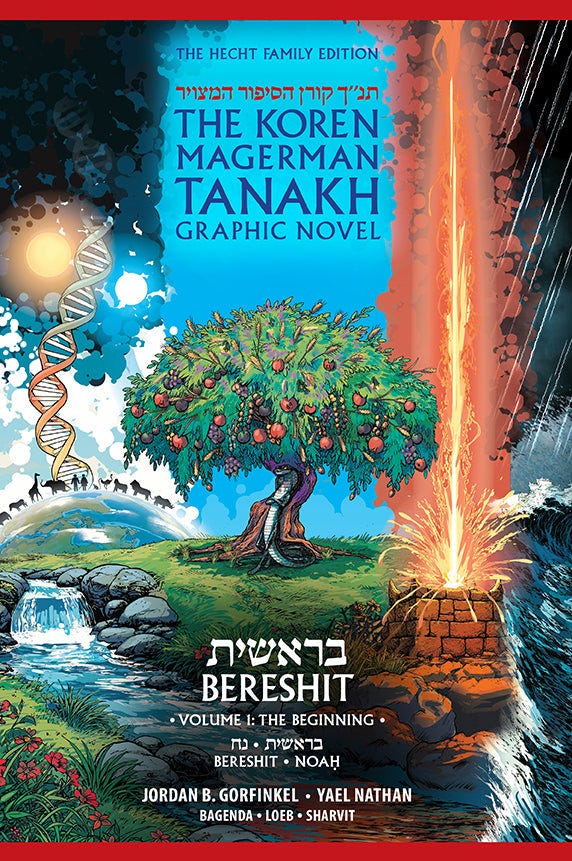
It’s a tree—likely the Tree of Knowledge, since there’s a snake thing in front of it.
But it’s a weird tree. It’s growing wheat, grapes, and figs. The figs are a little hard to make out, but I know they must be figs because it is clearly referencing a Talmudic debate about what fruit was on the Tree of Knowledge. (There are also pomegranates, which do have ritual significance in Judaism but are only suggested as the fruit of the Tree in Christian contexts.) The snake, too, is weird: It has hands and legs! Of course, I know that this is because the rabbis imagined that the snake originally had arms and legs, only to lose them as punishment for feeding Eve the forbidden fruit. This is a very clever illustration, indeed.
But what would you see if you didn’t already know these things? Well, I guess you just see a strange tree and a strange snake. This is interesting, but it doesn’t clearly mean anything unless you have the textual key.
This design choice recurs throughout the book. On page 10, there is an illustration that is technically quite clever: the primordial chaos of the world is represented as a black page, but superimposed on that black are transparent, glossy Hebrew letters, which you can see from certain angles and are slightly raised against the page. The letters, of course, represent the idea that God created the world with the power of the Hebrew letters themselves (this is a kabbalistic notion, and the sefirot appear in many places throughout). This is very cool. I love it. Will a child?
The most heavy-handed instance of this strategy is on the very first page, which is wordless and bears no relationship to the text of Genesis at all.
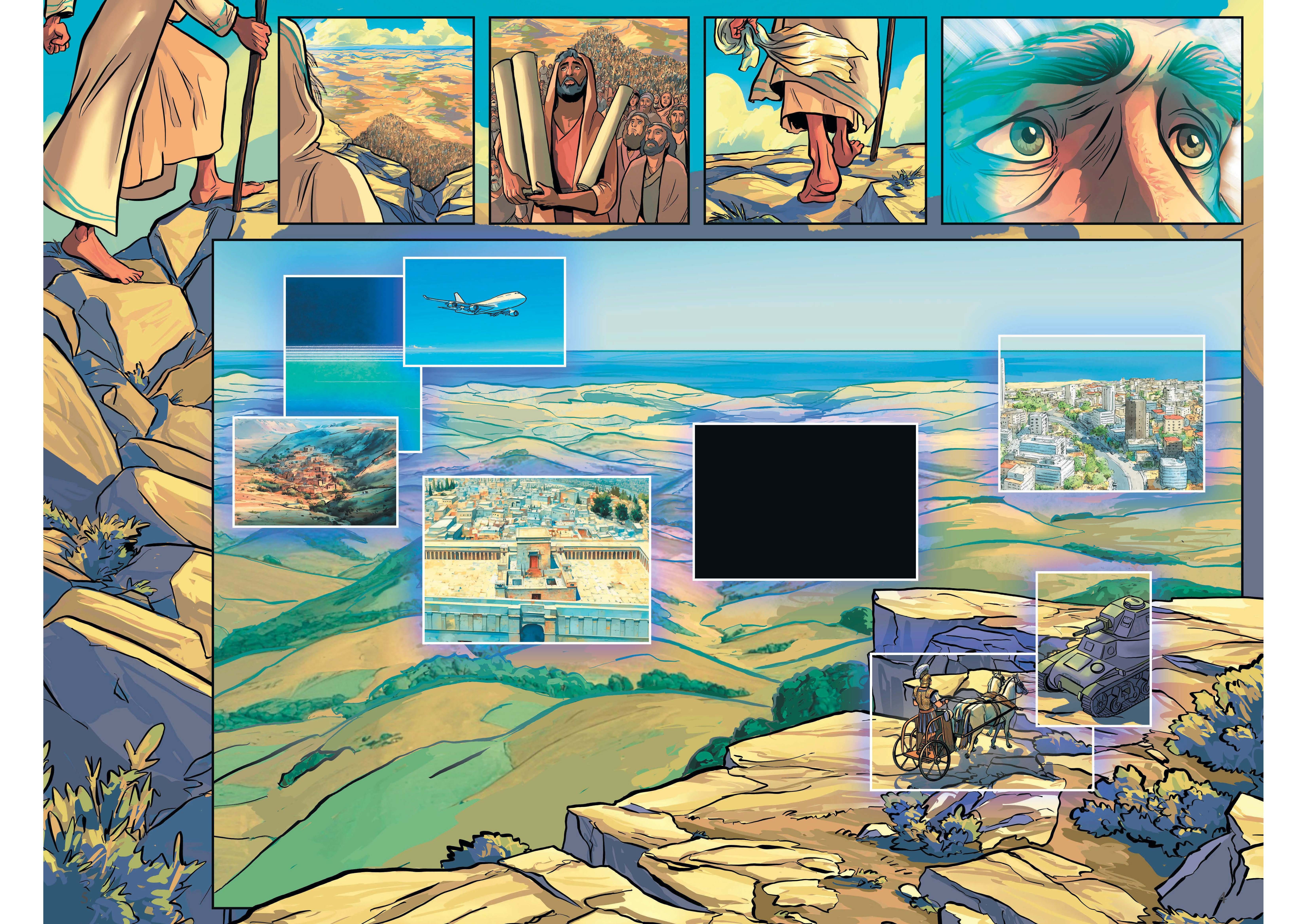
Some readers will be very confused about this illustration and will remain that way, because this page is never explained. Of course, I know that this is not an illustration of the text, but of Rashi’s first comment on the Torah, where he declares that the Torah rightfully should have started with the first laws given to the Jewish people. The only reason for this prologue, he says, is to demonstrate that God made the world—and because God made the world, he can give Israel to his chosen people. Koren’s edition boldly begins with a depiction of this idea: This is not really a story about the world. It’s a story about a land and a people—and Koren, which has offices in both America and Israel, is directly extending that idea to the contemporary state.
Bracketing the Zionism piece: Is this a smart choice? It’s certainly a bold one, the boldest I’ve seen in any Koren edition. But, again: This page is completely inscrutable to anyone who hasn’t learned that specific Rashi.
Creating a new visual language
Here’s the thing, though: What I am identifying as a problem is quite typical of Christian art. It’s only strange to me because there are so few Jewish depictions of the Bible of this caliber.
Consider this representation of the crucifixion from the late medieval Biblia Pauperum.
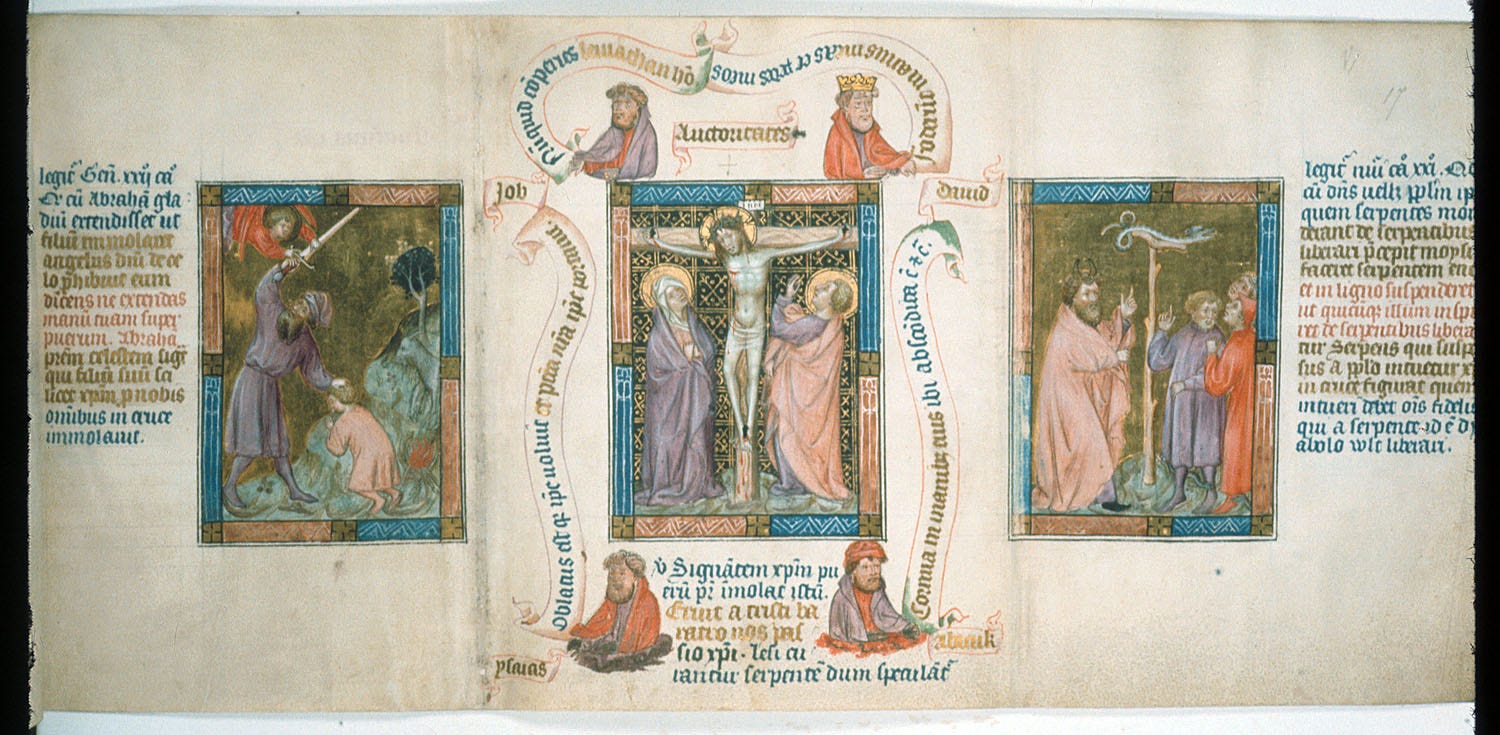
The crucifix is centered, flanked by two stories from the Hebrew Bible: the sacrifice of Isaac and Moses holding a bronze serpent on a pole. Why the juxtaposition? Because Isaac’s sacrifice prefigures Christ’s, and because John 3:14 says, “Just as Moses lifted up the snake in the wilderness, so the Son of Man must be lifted up.” But you need to know a thing or two about Christian interpretations of the Old Testament to understand this.
In other words: It is totally normal for Biblical illustrations to be “deep cuts,” paying homage to an interpretive tradition in a way that rewards the viewer’s knowledge. Kids may not get it, but that’s fine.
How strange it is that we are confronting this problem only now, and only in a comic book. That’s one price of disenfranchisement, I guess.
On the edge of something greater
And then, once in a while, the book goes a little further.
For example, I will eat my hat if this blue eye / red eye is not a reference to The Matrix.
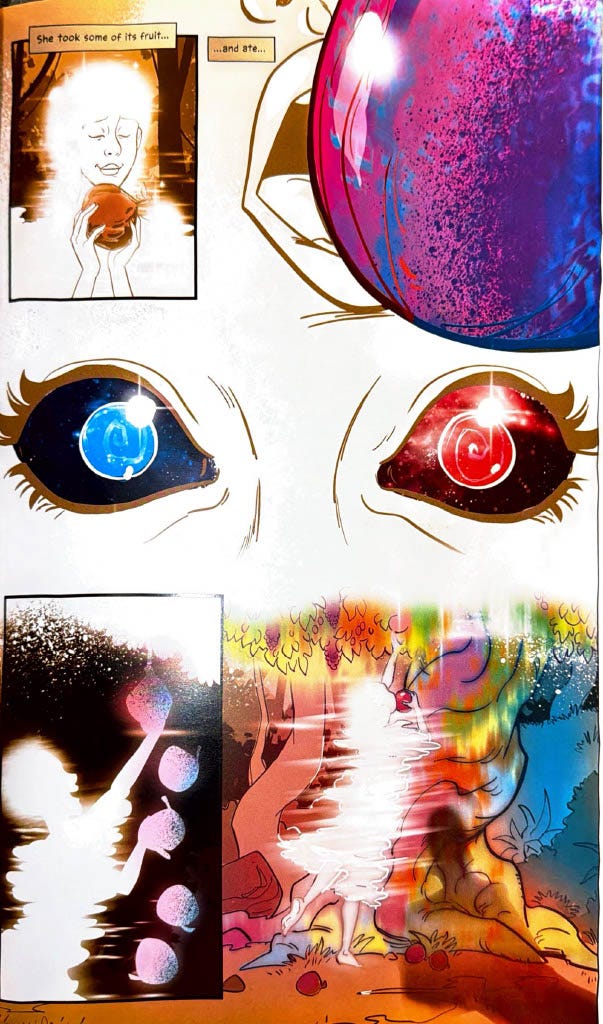
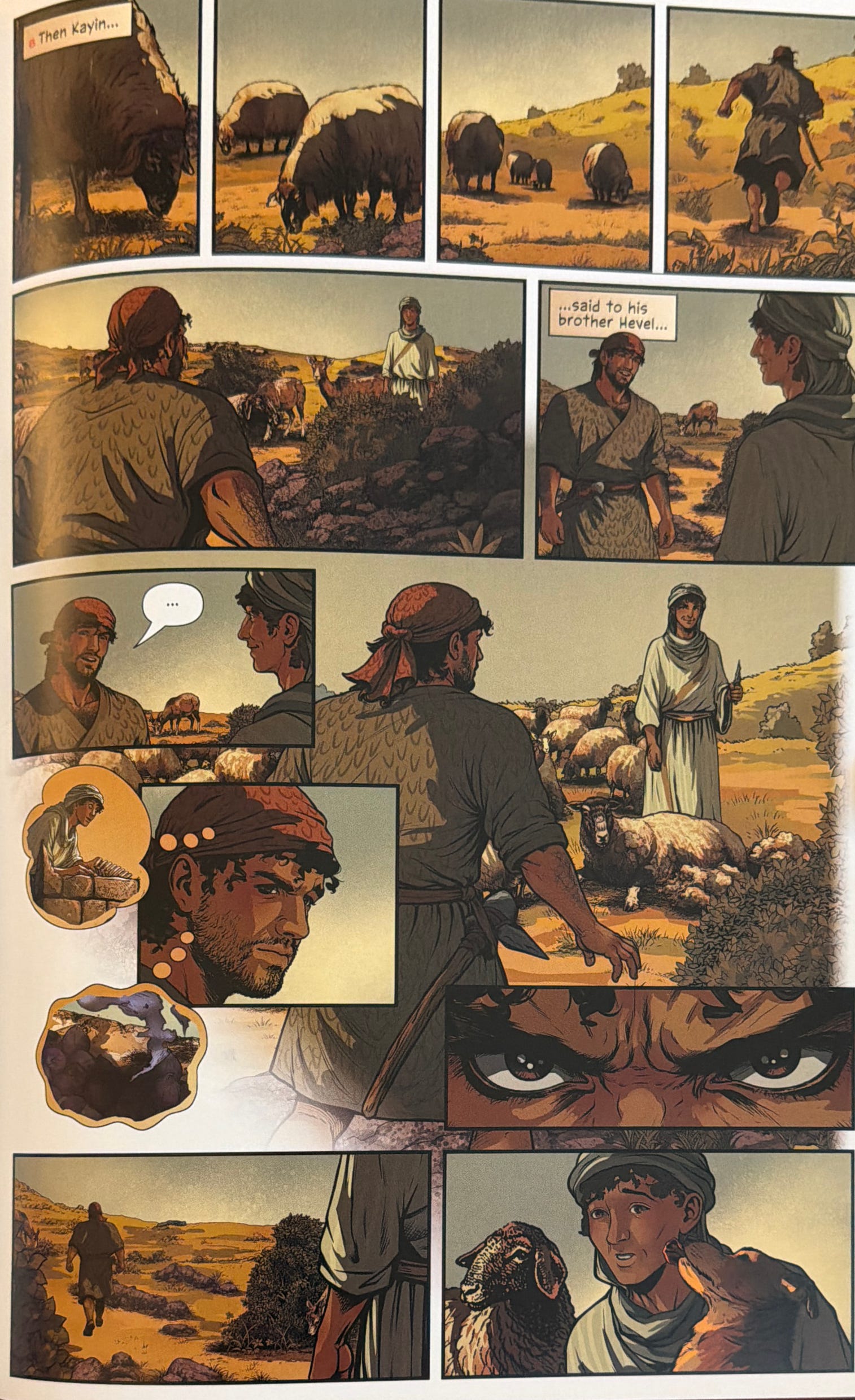
And you know what? I like it. I also like how it takes full advantage of the famously incomplete exchange between Cain and Abel, where Cain talks to Abel but we don’t know what he says. The less the Bible says, the more room for interpretation.
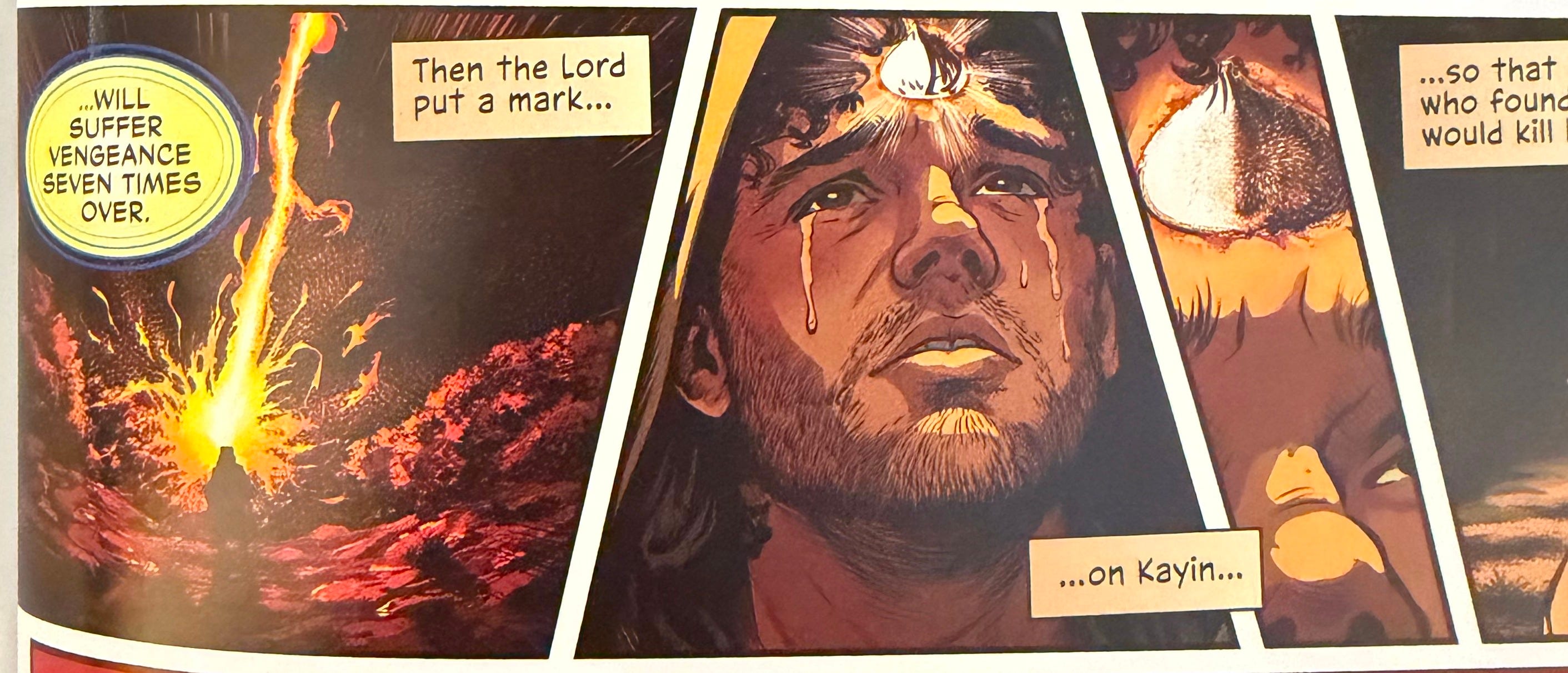
Even more, I like this choice to have Cain’s mark be in the shape of a fig, which (not coincidentally) is also the fruit that Eve eventually eats. I don’t quite know what this parallel means, but it invites interpretation. That’s exactly what I want a book like this to do.
As someone who has watched the development of Koren’s illustrated books, I think it is safe to say that this one is a big step forward. It makes bolder choices, it has a clearer point of view, and it more thoroughly engages with midrash and commentaries. The result is a work that feels a lot less obvious than their Book of Esther or Book of Jonah.
It is still mostly coloring within the lines of existing interpretations, but it’s asserting itself a bit, too. The reconciliation of Torah and science is a decades-old project, but illustrating that reconciliation is truly original. And when it goes off and uses the text’s silence to develop its own ideas? That’s where it really shines.