
This is a transcript of a Belief in the Future episode; it has been lightly edited and there may be errors. You can listen to the episode on Spotify or Apple Podcasts or anywhere else podcasts are available.
DZ Kalman (Intro)
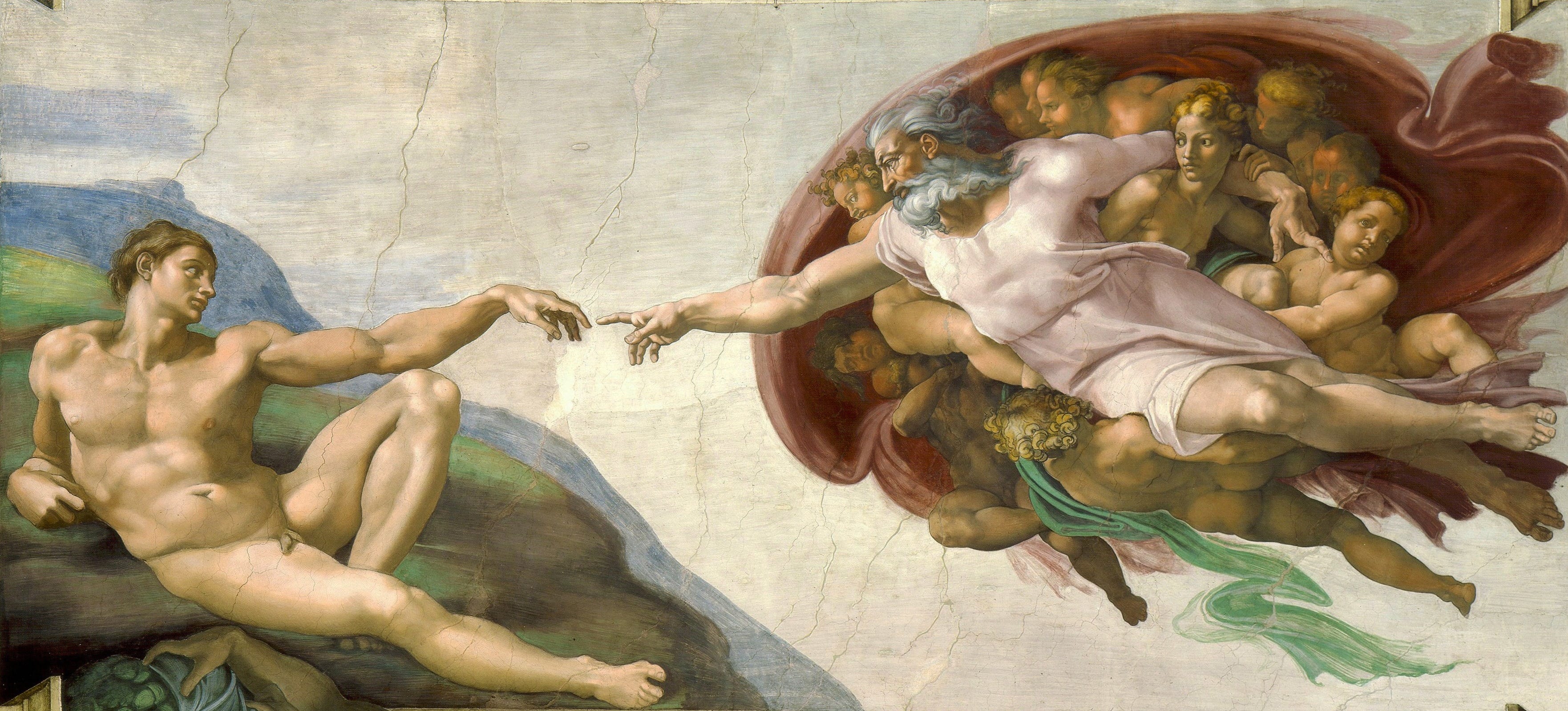
Alright, here’s an experiment. Go to any rabbi, any priest, any minister, and ask them what their religion has to say about artificial intelligence. Whatever comes out of their mouth, there’s a good chance that within 5 minutes they will say one specific phrase: the image of God.
The idea that human beings are created in the image of God is a central part of both Jewish and Christian theology, and with the rise of AI, it has become perhaps the best example of how ancient religious wisdom can moderate modern technology by reminding us of what we value most of all. If human beings are created in God’s image, if we have something in us that separates us from animals, then we have an idea to rally around, a way to articulate that humanity’s special status needs to be preserved at all costs.
Of course this concept, what Christians call Imago Dei and Jews call Tzelem Elokim, it’s not just used for articulation. In very real ways, the idea human beings share some essential feature with their creator has shaped our conception of ourselves, maybe most importantly in matters of law. For the Hebrew Bible, the special status of humans is listed as the reason why murder is illegal, and the concept of human dignity that grew from this theology has become so successful that is has almost entered into the realm of self-evident truths, something so basic that it hardly needs justification at all.
But, there’s a problem, which is that this theological idea is a lot more unstable than we’d like to admit. The way we understand the phrase today is quite different from its original meaning, both because our understanding of humanity has changed and because Jewish and Christian understandings of God has changed.
As for law, well despite the fact that the idea has shaped legal systems, it’s also been remarkably slow. In fact the Pope’s recent encyclical points out that it took 18 centuries for the church to resolve the tension between human dignity and the existence of slavery. The most disturbing problem of all is that this idea which we’re currently holding up as a north star when it comes to regulating AI, it might actually be hurting more than it’s helping.
For example, if you think that the image of God in humanity is the fact that we can reason, or that we can make moral choices, well, what are you supposed to do when it looks like AI can do those things too? If being created in the image of God just means that humans are special, well, what happens when the list of things which makes us special gets decimated?
Now, you might say that these are only problems for theologians, but I really don’t think so. Our world is in the middle of a major realignment on what makes humans valuable, and it’s hard to have that conversation if you leave out the history of how we decided that we’re valuable in the first place. And because that history runs through religion, it is really hard to talk about the future of human dignity, or even the future of AI dignity, without understanding how we got here.
So, let’s ask. What exactly does it mean to be created in the image of God, and how has that idea changed over time?
The best person to answer this question is Tomer Persico. Tomer’s a research fellow with the Shalom Hartman Institute in Jerusalem, and he’s the author of the book In God’s Image: How Western civilization was shaped by a revolutionary idea, published by NYU Press last year. And I should say, Tomer’s book is not about AI in any way shape or form, but I think it is an essential read for our current moment and I think you’ll see why from the very beginning of our conversation.
Before we begin, you’ll notice the audio on Tomer’s end is a little degraded due to a technical issue during recording. Our editor Louis Gordon made a heroic effort to improve it. I thought it was a really excellent conversation. I hope you enjoy it.
My name is DZ Kalman, and this is Belief in the Future.
***
DZ Kalman
Let’s start from the beginning. What does the Bible say about human beings being created in the image of God?
Tomer Persico
Well, it’s right at the beginning really, chapter one of Genesis. Most people don’t know that the actual idea of being created in the image of God is not biblical. It’s pre-biblical. You’ve got it in the myth of Gilgamesh, which is like, 2000 BCE. You’ve got it in Egypt. But of course, the very big difference is that in all those cultures, only specific people were created in the image of God. So the Pharaoh was created in the image of God, or Gilgamesh himself was created in the image of God. What the Bible does is, of course, create everybody in the image of God. Make each and every human created in the image of God and what that does is that it gives the same quality or the same special right that Gilgamesh had or that the Pharaoh had to all of humanity. And I think this is an important point.
If anything, if people even think about the image of God, usually they think, well, the image of God brings about a certain essential equality between all people. Like, we’re all created in the image of God. That is true, but it’s not the only thing. What the image of God also does is make people significant and make people unique, each and every one. Okay? And it makes the person’s status into something special. So if the Pharaoh was created in the image of God, that Pharaoh, that person, would rule Egypt. What would make him legitimately the ruler of Egypt? Of course, he was created in the image of God. Others were not. And as we see in the biblical narrative, just after God creates humans in the image of God, he immediately tells them, “Be fruitful and multiply,” and “Rule the seas or the skies,” right? Every being on earth is under your rule. Why? Obviously, again, because people are created in the image of God, and they are not, the rest of the creation. And so there’s this significance to human life there that grants them importance, right?
DZ Kalman
I want to unpack something because we’re talking about this phrase, “the image of God”, and we’re talking about it creating rights but in the original context, both the biblical context, the Mesopotamian context, what does it actually mean to be made in the image of God? Is there a specific idea that we are supposed to understand as readers?
Tomer Persico
In the context of antiquity, and specifically the Bible, and even the Talmud, it really literally means the form and figure of God. Really, that’s what it means, and I know it’s hard to hear that. I know it’s controversial, but I could give you loads of evidence that that’s what they mean, right? It’s very clear that this is what they mean. For them, God had a form, an anthropological form, and God made people in that form. So we’re similar to God.
DZ Kalman
There’s a text that you put in the book that I didn’t know before and I found truly shocking. This Midrash, this early rabbinic explanation of Biblical text, you know, in Genesis Rabba says that, “When the Holy One, blessed be He, created Odam (Adam), the ministering angels mistook him for a divine being and wished to exclaim ‘holy’ before him.” That is to say human beings, Adam, looked so much like God that the angels actually could not tell them apart.
Tomer Persico
That’s right. And immediately, of course, the angels say, “Kadosh, kadosh, kadosh,” holy, holy, holy, right? Which is what the angels do in the presence of God, right? And there’s another Midrash that I bring. It concerns the punishment of hanging. There is a punishment by hanging in the Jewish sources, but Jews are obligated to take the body of the hanged person down really very shortly after they are dead. Now, why is that? And the Midrash says, well, you know, it’s like a king that has a twin brother. If that twin brother is a robber and he’s caught, he’s hanged. But we don’t want really that people going near the gallows will suddenly be confused—“The king is dead!”—will suddenly think that someone has hanged the king. So in order to prevent that confusion, please take down the body of the hanged. And that is why humans, hanged humans, are being taken off, not only because of the dignity, right, of the human person, but because they are similar to God and we don’t want people to get confused, right?
DZ Kalman
Yeah. So again, just, just to foreshadow this a little bit, that, that’s one of the reasons why I find this such a helpful conversation within the AI context because of this almost uncomfortable level of resemblance between one being and another that we are supposed to understand as being very, very different, right? That, that it’s not just like, yeah, they share, like, some passing resemblance, like, oh, they’re similar in this one specific way. No, no. They are similar in many ways, in ways that actually make the rabbis, make angels, make God uncomfortable in some way.
Tomer Persico
You, you mean the AI model?
DZ Kalman
Yeah. Right.
Tomer Persico
I will argue that they are also dissimilar in very many important ways, right?
DZ Kalman
Yes.
Tomer Persico
But that’s the reason for the confusion. I mean, if we are talking about confusion, yes.
DZ Kalman
It’s almost like the angels are failing the divine Turing test, right? They’re—
Tomer Persico
We are.
DZ Kalman
Right. We made them fail the Turing test, right? Yeah. They’re supposed to know the difference between God and people, and they don’t.
Tomer Persico
Yeah.
DZ Kalman
Yeah. So I want to bring you back to what you were saying before. It sounds like immediately within the biblical context, saying that human beings are created in the image of God also confers certain kinds of rights and responsibilities, right?
So early on in the Bible, in Genesis 9:6, you have the prohibition on murder that is explicitly linked to, yeah because people are made in God’s image. So can you talk about the relationship between the image of God and actual practice?
Tomer Persico
Right. So I mean, basically we need to acknowledge, and I think it very easy to do so, that the idea of the human person that we have influences the way we legislate. The minute the idea that people were created in the image of God is introduced, it immediately influences legislation. So as I show in my book, you can compare different legislation about same cases of criminal acts or arguments between people or clashes, et cetera, and you can see how the idea of the image of God influences the biblical legislation.
To give an example, in Hammurabi’s law, and Hammurabi is the king of Babylon 1800 BCE, and really in all Mesopotamian ancient law, Assyrian law, et cetera, people can be punished for the sins of others. Specifically, you can be punished for the sins of anyone in your household, and especially the patriarch, the head of the household, the paterfamilias, right? If they kill, let’s say for example, the son of another patriarch, and you are the killer’s son, you get killed, right? So in one way, of course, the logic here is measure for measure, right? But we today don’t think anyone should be blamed, let alone punished, for the sin of someone else or the crime of someone else, and that’s exactly what’s happening. Why? Because the person there is not considered an individual in and of themselves. They are sort of an appendage or an organ, and sometimes the property of the patriarch, of the paterfamilias, right? They, the paterfamilias, are the only legal subject in, in the area, right? They’re the only ones who have, who have real agency and responsibility. All the others are influenced by what they do, right?
So that’s Hammurabi’s law, so that’s Assyrian law, and we see the Bible take argument with that law. Reject that logic, right? And so you see in Deuteronomy, the law about killing is—and they say explicitly—“Fathers should not be killed for their sons’ sins, nor sons for their fathers’ sins.” Why? Because in the image of God, God created man or human, right? And if so, each and every human life is significant in and of itself. You can’t just replace people. They are all so unique. They are irreplaceable, right? Right. So all this logic is encoded in the legislation that now takes effect in the Bible.
DZ Kalman
I think you’re pointing to an important initial step in this conception of the image of God that often gets missed. People talk about the image of God as equating to people are all incredibly valuable. But before you get to that step, you first need to get to a place of, people are individuals. People deserve to be treated on their own, you know, for liability purposes, for agency purposes. And we, I think even more than the idea of human beings have incredible value, kind of take it for granted that that’s how you should think about people.
Tomer Persico
Of course.
DZ Kalman
But there’s another way of imagining society where human beings are kind of cells in a body and, you know, you don’t really care about the life of any individual cell. You care about the life of the body, and this is saying, no, we care about humanity on the level of individual human beings.
Tomer Persico
When we are talking about significance and uniqueness of each and every person, we are talking about individuality. That’s what we’re talking about, and really the image of God is the beginning of individuality in the Middle East. I don’t want to say all the West. Rome and Greece had their own beginnings of that.But it really is the beginning of individuality. And, and that’s why the legislation is different, right?
DZ Kalman
I want to bring another text into this, which is an early rabbinic text in the Mishnah in Sanhedrin, where the rabbis describe how you’re supposed to admonish witnesses who are about to testify in a capital case to understand that, you know, condemning someone to death is a big deal and they should take it seriously. And then there’s this quite poetic description of the value of human life. This is where we get this idea that to destroy one life is to destroy an entire world, which shows up, you know, in Islamic context as well. And also this idea that there’s a fundamental difference between the way that God makes people and the way that human beings make objects. Whereas a human being, um, can stamp a coin, and every coin will turn out the same, but when God creates people, every person is different despite the fact that all of them are created in the image of God.
Tomer Persico
Yeah. This is exactly pointing to the uniqueness of each and every individual human life. Because when a king— I mean, who stamps coins, it’s a king, right? A king stamps his own image on his coins, and every coin is exactly the same with the image of the king. But when God stamps his image on each and every human being, each and every one is different. That’s the Midrash already saying, right? And this is really fleshing out the uniqueness of everybody, and of course, the significance of everybody because each and every person is a world onto their own, so saving a human life is saving a world, the Midrash tells us. And letting a human life die is letting a whole world be destroyed, says the Midrash, right? So again, the significance.
And in that same Midrash, by the way, there is also the emphasis of equality. Because the Midrash asks us, why did God create man alone and from one couple all humanity then sprang? So as nobody will tell another person, “My father or my ancestors are bigger than yours or more important than yours,” because we all have that same ancestor, right? So also, the equality here is underlined from the beginning.
DZ Kalman
So we have this notion of the image of God that starts out as being, human beings have some physical resemblance to God. When does that start shifting into some other kind of resemblance to the divine?
Tomer Persico
Here the story shifts to the Christian civilization, right? I think we can give the greatest credit to St. Paul, Paul the Apostle, who changed the meaning of the image of God from the physical contour of the human body or the human person, right, to an internal quality within all humans that is transformative and can go through a transformation that brings us to freedom and brings us to redemption. According to Christian theology—and this of course was developed mostly after Paul, but Paul already hinted it—the image of God was defiled in the original sin. Jesus came to Earth as a very concrete image of God, which if we turn to him, if we accept him, if we go through an inner transformation and embrace him, can also redeem our own image of God. And this move, this internalization of the image of God, is of supreme importance because it brings with it any number of shifts in the accentuation or the emphasis that we put on different qualities of the human person.
And really, that was Paul’s whole project. I mean, what was Paul’s mission? Paul’s mission was to bring Judaism to the Gentiles, right? How do you export a tribal religion and make it universal? Paul’s way of doing that was internalizing the crux of religiosity, right? Internalizing the most significant point of your religious life. So if for Jews: how do you express your religiosity, how do you worship God? By the covenant. There are laws that we agreed upon. We and God, there’s a covenant between us, and we go through rituals and obligations and observances, et cetera. That’s how you do it. That’s how you do your relationship with God, right? Of course, morality is in that also, it’s not only ritualistic. Right. Paul says, “Actually, my Gentile friends who I want to bring the good news to, actually you don’t need any of those external observances, laws, right? You don’t need to get circumcised. You don’t need to observe the Sabbath. You don’t need to eat kosher. What do you need? You need an inner faith. You need an inner transformation, a conversion, a born-again experience, by which you embrace Jesus or you are intimately connected with Jesus, and then you’re saved. That’s it. And you’re Jewish,” as far as Paul was concerned. “You’re really Jewish, right? You’re heirs of the promise God made to Abraham, and you’re redeemed,” right? So Judaism is at once internalized, privatized, because the covenant is between me and God personally, and universalized. Because if everybody can internalize and privatize their Judaism, everybody can do it equally, and Paul says, “There is neither Greek nor Jew. There is neither slave, nor bound. There is neither male nor female.” Imagine saying this at the first century, because all of you are one in Christ Jesus, right? And that’s the shift. That’s the revolution.
DZ Kalman
Part of what I hear you saying is that there’s this shift from an individuation that has mostly legal significance to an individuation that has deep meaning for people themselves, right? You should see your life as an individual. You should see your relationship with God as an individual relationship, and this kind of individuation reaches its fulfillment in some ways in that Pauline doctrine.
Tomer Persico
And remember, your connection to God 2,000 years ago was everything, right? Everybody, of course, was religious. There were no secular people, right? And your connection with God is your connection to truth, is your connection to eternal life, is your connection to meaning in life, to your goal in life, to redemption, to purification. It’s everything, and Paul makes that relationship internal. So you’re not dependent on anything. And nothing constrained you from it. And again, this is another step really, in the creation of the Western individual subject, right?
DZ Kalman
So one thing that’s striking is that all of this is happening in a society that is still profoundly unequal, right? A society in which slavery still very much exists and would continue to exist for hundreds and hundreds of years. Of course. So there is some disconnect between this philosophical notion of human individuation and the circumstances in which people are living. Although, I think as you write in the book, it offers a kind of pathway towards the end of slavery. So can you talk about how slavery enters into this?
Tomer Persico
But let me, even before that, talk generally about what you’re saying. Because of course, it’s not that ancient Hebrew culture was a liberal culture, even though it had the idea of the image of God. And of course, when Paul comes along, it’s not that the early church was liberal in any significant way, right? Even though it embraced that idea and carried on that idea. Obviously not, right? But what I want to say is that it’s important to understand how revolutionary that idea was. The fact that it’s so revolutionary is only understood on the background of what the ancient world is and what humanity is. Because for you to think that your group is better than the other group, or that if you’re able to do so, it is legitimate for you to own other human beings and enslave them. Or that if you’re a man, you are better than women or more superior than women, that’s just every culture in the whole of the ancient world, right? Except here and there. And what this idea, the idea that everybody, that all humans were created in the image of God, what it introduces is actually the opposite, right? That’s why it’s revolutionary. It says, well, actually, you know, essentially we’re all equal. And actually, we’re all significant, right? And we all deserve to be free, and we all deserve a decent life, and to be treated with dignity. That’s what it said. And it goes against the grain. But among these, slavery. Because every ancient culture had slavery in different form, right? But when that idea is introduced, so first, as we talked before, the laws of the Bible already respond to it and change accordingly, right? And so people are punished for their own sins, not the sins of others.
And then when Paul introduces this idea, yes, it’s not that the Christian Church all of a sudden became egalitarian, but it was more feminine and treated women with more equality than the cultures around it, right? And you can see the skip from ancient Judaism to Pauline Christianity, the first centuries of Christianity, already you can see. I’ll give an example. In Judaism, only a woman can be adulterous, right? A married woman that sleeps with a man who is not her husband is committing adultery to her husband, right? Paul says, and he mentions this explicitly in his letters, “No, both sides of the couple can be adulterous towards each other.” If the man, a married man, sleeps with another woman, that’s also adultery, right? And I think we can ascribe this beginning of egalitarianism already to the idea that the image of God is something internal, and your connection to God is determined not by your gender, but by your inner disposition, right? And then we know that the church has nuns and not only monks, et cetera, et cetera, right?
Now, if we talk about slavery, again, I don’t think it is a coincidence that the first formal rejection of the whole institution of slavery, the first condemnation of the idea that people can purchase and enslave other human beings comes within Christianity in the fourth century from Gregorios or Gregory of Nyssa, right? It’s the first time, and I want to make clear, it’s not that other cultures didn’t think it was proper to treat slaves decently, right? But it was that shift to an internal connection with the truth, with freedom, with God, that there comes an idea that it’s just absurd to own such an entity, to own a human subject, to own a subject that can internally communicate and commune with the divine. And Gregory says, “Do you actually believe that the giving and getting of a few coins has made you the owner of the image of God? That’s preposterous. That’s crazy.” And here we have again, we— So, so now did the church abolish slavery? Obviously not. We know that even in the 19th century, there were still churchmen who defended the institution of slavery, and others who rejected it, of course, right?
DZ Kalman
Right. Frederick Douglass actually says that he much preferred to work for secular slaveholders than religious slaveholders because the religious ones, they owned people with a kind of fervor and a sense of, “The condition which you’re in is deserved,” in ways that folks who did not believe the Bible was backing them at least did not have that piece.
Tomer Persico
Okay. Yeah. I mean, that’s really shameful. And you know, maybe this is a good point to say, there’s nothing deterministic in the idea of the image of God producing 3,000 years later the liberal order, right? You can have the idea of the image of God, and 3,000 years later you can have the ultra-Orthodox Gur Hasidic court that discriminates between Jews and Gentiles, men and women, et cetera. But again saying that the conditions for the liberal order are made by that idea. It’s not a sufficient condition, but I think it’s a necessary condition for that liberal order to be produced, right? Or to develop.
DZ Kalman
I want to tie this back to the AI conversation. Within the context of AI, there is a lot of anxiety around what it is that human beings can do that is special or different, and I think often a kind of contemporary conflation of, the image of God means that people can do this thing or they have this feature that nothing else has and that is why they are deserving of this elevated status.
My sense is that, when Paul is thinking about the image of God, he’s not thinking about some kind of specific characteristic that people have. We all get what it means to be human. We all get that human beings are different from animals, but in the medieval period there’s a shift. There’s an attempt to articulate what it is specifically within the human being that makes them special. Can you talk a little bit about how that develops?
Tomer Persico
Approximately at the 12th, 13th century, there was a consensus building in Europe, specifically Italy, and specifically within the church, that the image of God is really reason: the ability to be reasonable, to have a sense of reason, and for them also to discern between right and wrong, and to decide what to do, right? At the same time, the idea of rights is for the first time articulated in a very concrete way, and this is with the Magna Carta, right? 1215, England, King John grants his subject rights. Right? But these are different rights than what we today call human rights in two respect.
First of all, they’re not inherent and universal. They exist only because the king allowed for them, right? The king signed the Magna Carta. It’s a contract. We think of human rights as inalienable, as essential, inherent, et cetera.
The second difference is that they were not equal. Different subjects got different right according to their status. So nobility got certain rights, clergy got other rights, freemen, which were male property-holding Englishmen, got a third bunch of rights, and serfs and poor people also got rights, but much lesser rights. So they’re not equal. But these ideas come together, and at a certain point it’s becoming unbearable for Christians to think that they can really trample over or infringe on the ability of other humans, even non-Christians, to use their reason and to decide for themselves what is right and wrong. Because this is the image of God in them. And if God gave them the gift of being in his image, how can we trample it? How can we infringe upon it? How can we ignore it, right?
And so you’ve got a pope like Pope Innocent IV, in the middle of the 13th century, that writes in his gloss on Genesis, he writes, “Look, actually, when we think about it, we cannot infringe upon the property, the judgment, and the rulership, the government not only of Christians, but of pagans and of heretics. They also have the same gift that we have from God, the image of God, the gift of reason, the gift of assertion, moral assertion.” And they imagined the pope, who then is the strongest person in Europe, obviously, right? Holding armies, the Crusades are going on, right? And he, out of no compulsion, is limiting himself. The Church is limiting its own authority.
It’s an amazing moment. And why? Not because somebody forced him, but because there’s an idea that seems impossible to deny, right? The idea that reason is mutual to all people. It is the image of God in them, and I, as a believing Christian, cannot infringe upon it, right?
DZ Kalman
Yeah. Of course one problem that can result once you become clear about what it is in the human that makes them similar to God is that you can start thinking about, well, do all humans really have this? What about a human being who’s not so good at reasoning? What about a human being who seems to lack certain capacities?
And look, this comes up in contemporary bioethical context as well. When do we talk about the human being as mattering simply because they are flesh and blood, and when do we talk about the human being in terms of their personal capacity? And I think we have rightfully a lot of fear about evaluating human beings on the basis of their specific capacity. Does that start showing up in the medieval period as well?
Tomer Persico
That’s exactly what happened. That’s exactly what happened in the next few centuries. There’s a switch here, right? The Pope says, “We learn from the Bible that because we are human, God grants us reason as His image of God.”
The switch is, folks who don’t have reason aren’t actually human, right? And then when is this coming up? It’s coming up when the conquistadors of Spain and Portugal reach what is today South America, right—the New World—and discover a lot of pagans with a lot of gold, right? And what do you do with them? So if we are true to our Christian teachings, they are human. They have the image of God, and the Pope already told us 200 years ago that we can’t simply take their property because that’s their right. So one of the ways in which to get around that is saying, “Look, they’re not really humans because they’re not really reasonable. I mean, look at them. They’re barbaric, they’re primitive, they’re just crazy,” right? And so we don’t need to take into account what the image of God would, would dispose us to, would oblige us in, because they’re not human,” right?
And you can see multiple discussions and polemics within the church with activists like Bartolomé de las Casas, who in Mexico is a very important figure. He was the first bishop of Chiapas, and he’s a sort of social reformer who, who tries as much as he can to stop the Conquistadors from butchering and stealing from the Native Americans in what was then the territory of Mexico, right? And you’ve got other people like Cardinal Roberto Bellarmino, or Belleramine in English, right? Also an Italian cardinal that says, “No, actually, we cannot do what we are in fact doing to the Native Americans in South America because they are human.” Columbus himself, in what is today Puerto Rico, did not allow the missionaries that came with him to baptize the indigenous people there because baptizing them would be admitting that they are human, that they have a soul which must be, of course, converted to Christianity, no doubt about that.
DZ Kalman
A couple things about this, because I think this is a really key piece. One is just to kind of extend the story. There’s this incredible book by Michael Adas, called, Machine as the Measure of Man, and it’s about this encounter with the New World and about how the way in which we evaluated human beings shifted from Christian theology to something about science, right? Human beings that have science are more valuable in some ways than human beings that don’t, to eventually technology, that human beings that are technologically sophisticated have greater rights or deserve greater respect than those who don’t.
And this gets to a tension that I see in the AI conversation all the time. Which is, do you care about human beings because they are human beings, simply because they are? Or is there something you need to demonstrate as a human being in order to have status? And it’s tough because I don’t know that you can actually entirely distinguish those two things. People don’t simply exist as human beings. They’re always in some ways performing their humanity.
Tomer Persico
I mean, I think, I think first of all, people do exist as human beings. And the crux or the essence of the idea of the image of God is that each and every person has the image of God, no matter what, right? And by the way, it’s not only, with AI it’s also in the way we treat people who are disabled, right? Or even people who are in a coma. A person who is in a coma, do we dignify his or her human life even though they lack everything that we see as valuable in a human life: autonomy, reason, consciousness. And I think we as a society, think that these people, these humans, need still to be dignified as human beings. We can’t just chuck them out, right? We can’t just pull the plug without a second thought. There is some inherent dignity even in that living human who, except for being alive, has no other human characteristics.
DZ Kalman
Yeah. There’s this early modern responsum, it’s like a Jewish legal text, about whether it is acceptable to count a golem, an artificially created human being created using mystical practices, to count a golem in a minyan, like a Jewish prayer quorum. Do they count as a person enough to constitute part of a prayer community? And the response is basically like, We don’t even count all people in a prayer quorum, right? We don’t count people who are mentally incapacitated in a prayer quorum. What are you talking about golems for?
So there is a way in which, again, the AI conversation exposes the fact that there is not a universal standard. And you didn’t mention this, you know, we can talk about people in comas, we can also talk about fetuses, which obviously is another area where you have this, you know, you have liminal human beings.
Tomer Persico
Of course, and by the way, you can understand the view of the Catholic Church now, right? If indeed every human is created in the image of God, and it, it really doesn’t matter if they are inside a woman’s belly or outside of it, right? They are in the image of God. That’s it. They don’t need to think, they don’t need to know how to talk. They don’t need to be self-reflective. That’s it, right?
DZ Kalman
Whereas in rabbinic literature, you know, and I was talking with Sarah Ronis, about this a few years ago. The rabbinic response is much more likely to start with practical questions of, what do I do in this specific situation? Like, I think about not just, can I abort a fetus, but can a fetus own property? Those questions don’t need to be linked through some kind of ontology or some deep theology. Instead, you kind of start with the more practical.
Tomer Persico
And yet the bottom line is that, for the rabbis, the fetus is simply not a separate human being. They don’t count as a human being all to themselves, and that is why abortion is much easier to allow in the Jewish tradition. Very late in the pregnancy, they just don’t count as separate human beings. And in the Catholic Church, that’s different.
DZ Kalman
I don’t want to mischaracterize her research, but even that understanding of the fetus as being a part of a human being is somewhat class dependent. It depends on whether you’re talking about a free person or a non-free person, and that the rabbinic discussion of it actually shifts as a result. The other text that I think is helpful here is within rabbinic literature, there is a difference between how you respond to a miscarriage depending on what the fetus looks like. If it looks more human, you respond to it differently than if it looks more animal. And so again—
Tomer Persico
You mean earlier stages in the pregnancy?
DZ Kalman
Correct, right. And it’s tough because I think there is a need to find a balance between these two things. And in practice, look, you know, we’re encountering each other through a computer screen, right? You know, we don’t have a direct perception of each other as human bodies. So what that means effectively is that we need to perform our humanity in some ways in order to see each other as being human. You can’t easily separate out humanity as being and humanity as doing.
I want to make sure we have enough time for the next phase of this, which is the secularization of the concept. So right now, we have this idea that’s been brewing for literally centuries about the image of God across Judaism and Christianity, and at some point, that concept leaves religious language and starts appearing elsewhere. Can you talk about that shift?
Tomer Persico
Yeah, I mean, you can see that shift even in the beginning of the materialization of liberalism, which is the US Declaration of Independence, 1776; and the French Revolution, 1789. Already in the text produced in those instances, in the US Declaration of Independence, there’s the Creator, right? But not much else talk of God, and this God is a very remote, passive, deist God, right? And in the French Declaration of Human Rights, written in the French Revolution, there’s not even that. There’s not even the Creator there, right? Rights are sacred, but who made them sacred? We don’t know, right?
DZ Kalman
Right. And maybe the, the apotheosis of this is the Universal Declaration of Human Rights from the 20th century, right? Where it says, just to quote it, it says, “All human beings are born free and equal in dignity and rights. They are endowed with reason and conscience and should act towards one another in a spirit of brotherhood.” Without trying to explain it, just saying it axiomatically.
Tomer Persico
Right. This is the first clause of the Declaration of Human Rights by the UN, 1948, Eleanor Roosevelt, all that story, right? Which is an amazing document and, of course, historically very, very significant, and very much intent of ignoring or rejecting any religious language. Now, of course, there were many political reasons for this. The Soviet Union, of course, would not have any religious language, but also a wish to universalize the language of human rights and the language of human inherent dignity, and that is done by secularizing the language of that heritage that we got from the Judeo-Christian tradition.
And really what replaces the image of God in secular liberal jargon is dignity. We are all born with inherent dignity. We are all born with the essential importance and significance, and of course, we are all equal in that, et cetera, right? We can see this is used everywhere. This is, this is really the secular translation of the concept that we were talking about all along.
DZ Kalman
Yeah. So I find this secularization a really important thing to understand within the context of the AI discussion because one thing that happens through that secularization is you disconnect this idea from the mechanisms through which it was developed. And because of that, it becomes somewhat brittle even if it’s taken seriously, right? You don’t really have a sense of like, well, how did we get here? And when you have something like AI, how do you adapt or apply this principle to deal with it? And so you can have conversations around it, but if you leave the religious grounding out of it, it’s very hard to reason with it. And so you end up with questions about, say, for example, well, how do we think about human value if all of the things that human beings thought were unique to them are actually replicable by a robot, or actually replicable by a machine?
Tomer Persico
What is missing, what we are now lacking is the metaphysical anchor for the dignity of the human being, for the inherent value and significance of each and every human being, right? Because, of course, when God is there and we are made in His image, it’s clear why we are significant. If God is not there and we’re just treating everybody with inherent dignity: why? And how do we ground it, right?
Now, there’s a great liberal discussion, or inter-liberal discussion, about can the liberal order continue and survive and be resilient even if the metaphysical anchor for our liberal thought has long gone, and we don’t believe in it, or you know, not everybody believes in it, et cetera. But if we’re talking about AI, right? Again, we are in a situation in which there’s no inherent reason to believe in the superiority of human life or human beings, and we tend to reduce humans then to measurable characteristics: intelligence, memory, ability, performance, right? And if that is so, it’s very easy to go to the next step and say, well, you know, AI can do all that much, much better. So perhaps they’re not only better at that, but they are better beings. They are better subjects, right? And in fact, they are owed more divinity than human beings, right?
And AI here is complemented by post-humanist and transhumanist thought that have begun much earlier than AI, than large language models, and are with us for decades now, in which people have thought about somehow improving themselves, perfecting themselves, uploading themselves to computers, some singularity point in which everybody will become immortal because either medicine will be able to replace each and every body part that you lose, or your consciousness could be uploaded to some part to some cloud, right? And that’s it, right? And here, and AI comes into this discussion and very easily transforms the concept here, again, to what I just said, to say, well, you know, if you can upload your human consciousness into the cloud, why actually bother if there’s these much superior consciousness or intelligences that are already in the cloud and can do all that you do much, much better, right?
The question is, what is the human person? Are we simply a single stage in the evolutionary ladder? Are we simply very smart machines that can be replaced by smarter machines, right? Or do we have inherent value in ourselves, humans as humans, right?
DZ Kalman
I want to bring this to where you’re sitting not just within an AI conversation, but also living in Israel and as being very much involved in Israeli, political conversation. Maybe you can help me connect two threads. I found this letter a year or so ago by Yeshayahu Leibowitz. Yeshayahu Leibowitz being an, you know, important late-20th century public intellectual, political commentator. In some ways, presaging many of the difficulties that would arise around Israel’s treatment of Palestinians immediately after the Six-Day War, and then also had much to say about Jewish thought, about Jewish law. He has this letter to Norman Lamm, who is an American Jewish public intellectual, based on this very strange essay that Lamm wrote about theological implications of extraterrestrial life.
A bunch of people wrote to Lamm about this, because it was weird. Leibowitz wrote basically, like, “I don’t get what the big deal is.” Like, who cares if human beings aren’t the only intelligent, reasoning beings in the universe? That’s not important for Jewish theology. And when he writes, I’ll quote it to you. He says,
“Planet Earth has no advantage over any other part of the universe. Humans have no innate advantage over any other living creature. It is only serving God that grants humanity a special status, which does not depend on the structure of the universe or the nature of life and humanity. Here lies one of the profound contradictions between Judaism and Christianity, for in the latter, in Christianity, divinity was made incarnate on Earth in human form, and hence the unique importance of humans and of Planet Earth. Whereas our God is not reached by physical properties,” he’s quoting Maimonides there. “And the world is not God’s place, but God is the place of the world,” which is quoting a Midrash. Yeah. And then he ends by saying, “Christianity is anthropocentric. Judaism is theocentric.”
Tomer Persico
Okay. You know, I think Leibovitch characteristically misrepresents—
DZ Kalman
Everyone has strong feelings about Leibovitz!
Tomer Persico
No, I mean, I have a lot of good things to, to say about Leibovitch, but I think he many times misrepresents the Jewish tradition or takes a small part of it, usually Maimonidean interpreted in a Kantian way, and makes it Judaism, right? Which 99.9% of Jews don’t see as Judaism and don’t live like Leibovitch would have wanted Jews to live according to that theology.
So great, I mean, it’s a nice midrash in itself what Leibovitch said, but I don’t think Judaism is not anthropocentric. I don’t think Judaism doesn’t think— I mean, obviously, you know, we talked about the Bible and Chazal thinking that human form in itself is the form of God, right? Is the contours of the divine body. By the way, you, you got a second coming of that in Kabbalah, right? The language Jewish mysticism uses to understand and describe the mechanism and the inner workings of God is anthropomorphical and is shaped like the human body, right?
So again, it’s all over. And so, you know, I love Leibovitch in many ways, but I wouldn’t take that as a good representation of Judaism.
DZ Kalman
Yeah. But getting back to the second part of the question, where do you see this work that you’re doing on the notion of being created in the image of God and human dignity and value in relationship to the rest of the intellectual work that you do?
I’m asking because a lot of AI conversations are very abstract and feel very disconnected from the fact that these are ideas being produced in specific situations in specific parts of the world dealing with specific politics that are swirling around them. So I’m curious just for you personally how this connects to the other work that you do.
Tomer Persico
Of course! No, so it connects to the other work that I do. It connects to the public work that I do, or perhaps if we’re talking about intellectual work, it’s connected to my work as a public intellectual. And what I want to, to offer to the Israeli society is the centrality of the value of human life and the idea of the image of God as one of the most basic Jewish ideas that we need to take seriously, and we need to, to, to adopt or re-adopt and put center stage in our politics, in our society, in the way Israel works.
Unfortunately, I think we’re failing miserably in this, right? And my book, which was written in Hebrew before it was translated and updated and improved in English, was a suggestion to the Israeli Jewish society: take this idea seriously. You can’t only base your Judaism on, you know, the chosenness thing, or the all the observances which are very important, or the rituals.
Judaism is first and foremost the dignity, equality, significance, uniqueness of each and every human being. And again, what comes from that, what is downstream of that, is that ideas that we are informed by the liberal order, right? Ideas like universal humanism or feminism or rights discourse, all these are not foreign to Judaism, but are the logical continuation of the Jewish tradition in many different ways. This is what came out of chapter one of Genesis, and what came out of the Jewish tradition holding on to that idea and propagating it and underlining it and emphasizing it in many Midrash stories and in many laws. And as I said before, biblical law is already influenced by this. So these ideas that some of the more strict religious Jews reject as foreign, and Western, and Christian, and postmodern or progressive or woke or what have you, right, are actually to be embraced or at least to be in dialogue with, right? Because they are, in many ways, the continuation of our own tradition.
DZ Kalman
Right. Thank you. I think that’s a great place to leave it.
Tomer Persico
Thank you for inviting me.
***
DZ Kalman (outro)
Thanks for listening to the show. As always, I’d love to hear what you think about it, and you can help us grow by leaving a rating or review. This episode was edited by M. Louis Gordon, and our production manager is Misha Holleb. Belief in the Future is produced in partnership with the Faith Family Technology Network and is a production of Sinai and Synapses. Funding for Belief in the Future comes from the Templeton World Charity Foundation. Also, if you’re looking for a transcript of this show, you can find one on my blog, jellomenorah.com. That’s all for today. See you next week.