
Let me tell you about a six-page essay that haunts me to such a degree that it often makes my work feel worthless.
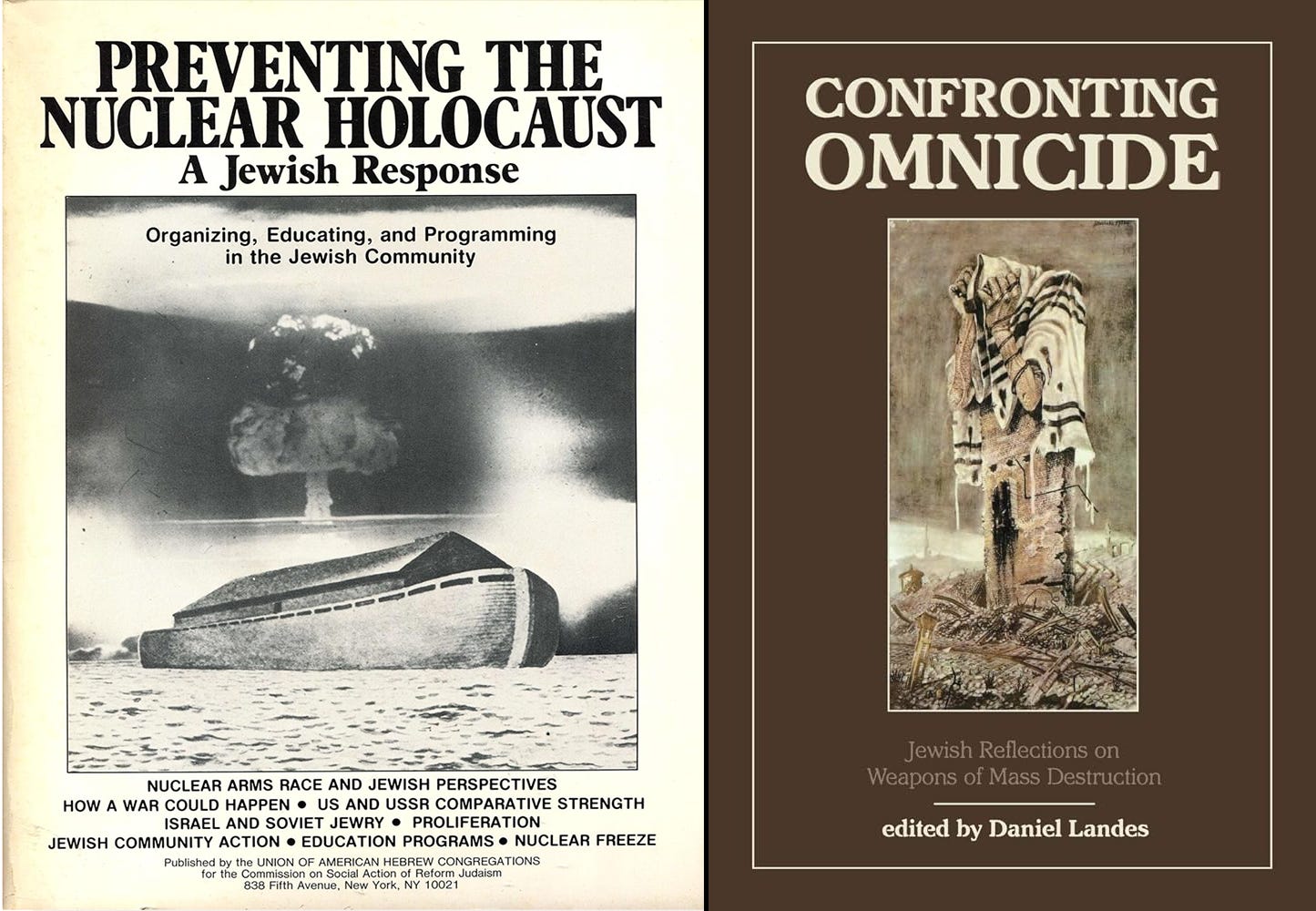
In the early 90s, as the Cold War was coming to a close, Rabbi Daniel Landes decided that it might be a good idea to figure out what Jewish thought had to say about nuclear weapons.
It was, admittedly, pretty late in the game, and yet very little had been said. Before Landes’ book, only a single(!) other book had been published about Jews and nukes, and this was really just a compilation of materials that had been published elsewhere.
Landes’ book is pretty good—except for six troubling pages that have disturbed me ever since I read them. I am troubled not just by what they said, but by the person who wrote them.
I want to tell you about those six pages, because they get to the heart of a major question: Who, exactly, gets to decide what “Judaism” says about AI or any other consequential technology?
One of these folks is not like the others
Landes’ book is called Confronting Omnicide, and in many ways it is an almost stereotypical production of 90s-era Jewish thought. It has contributions from fourteen rabbis (✅), includes exactly zero women (✅), and the authors are a veritable Who’s Who of late-20th-century Anglo-Jewish intelligentsia (✅). It’s like the Lollapalooza of Jewish philosophy.
Now, unless you are deep inside contemporary Jewish thought, you won’t know these names. But one name is different. Take a look at the second page of the table of contents and see if you can spot him. I’ll wait.
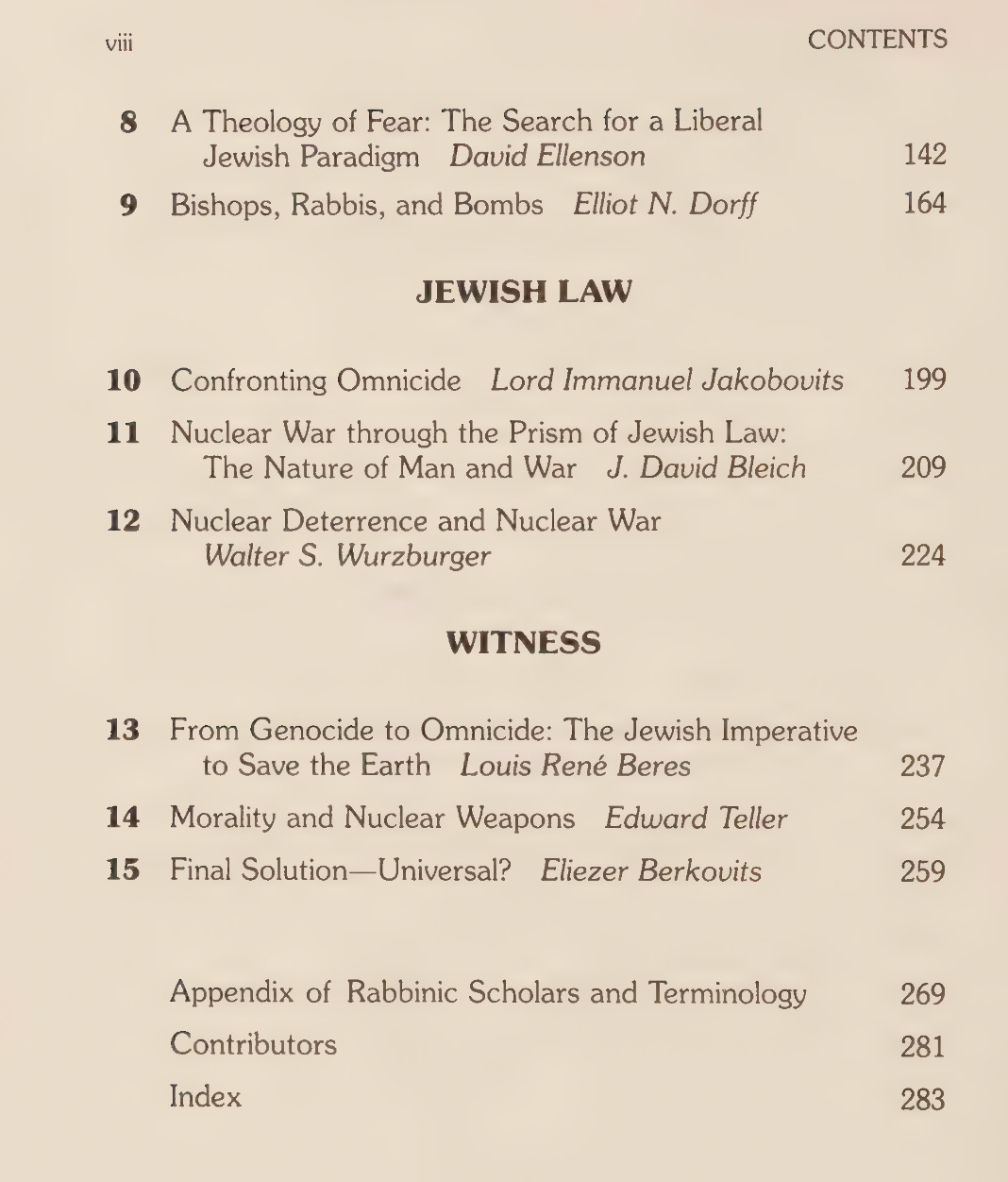
Edward Teller. The Edward Teller.
Edward Teller was not a rabbi, nor was he a Jewish philosopher. Nope; Edward Teller was the father of the hydrogen bomb. Somehow, Daniel Landes had gotten one of the architects of the nuclear age to write as a Jew for his volume of essays.
So what does Teller say, speaking as a Jew? Only just enough to disturb me forever. Here’s what he says.
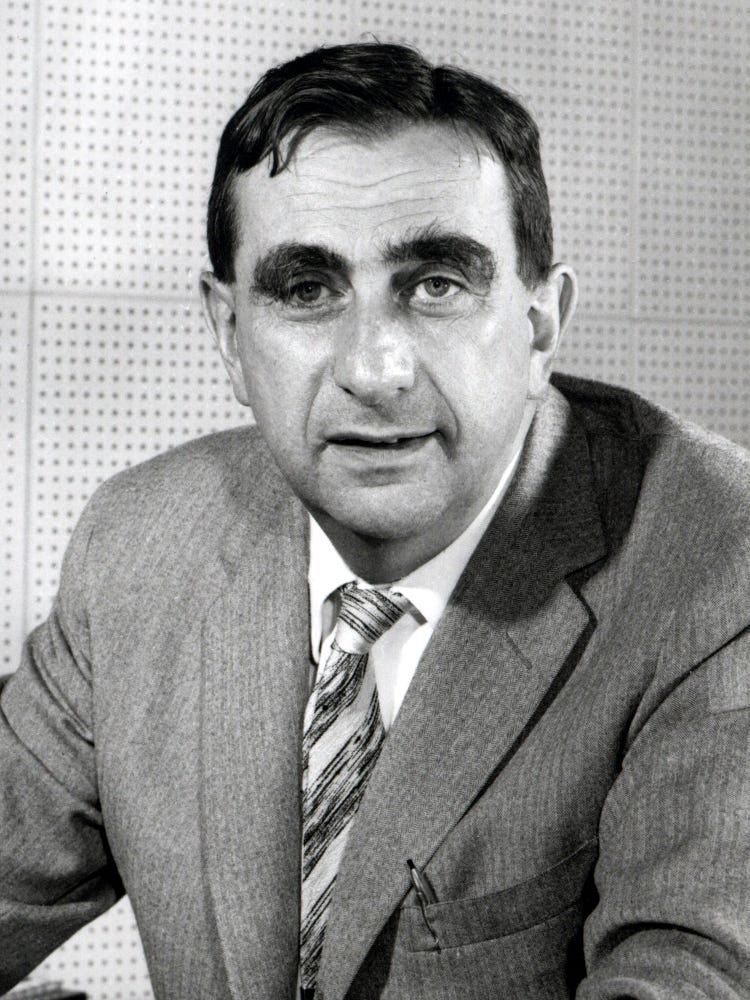
The nuclear true believer
First, a quick recap on Teller. If you’ve seen Oppenheimer, you might remember Teller as the physicist with the bushy eyebrows and the unplaceable Eastern European accent who thought the bombs dropped on Hiroshima and Nagasaki were too weak. He started developing fusion weapons during the Manhattan Project, continued the work after the war, and aggressively (and successfully) lobbied the government to support the project.
Many physicists, Oppenheimer (Jewish) included, felt deep guilt about their role in creating world-destroying weapons. Leo Szilard (Jewish), who co-authored a letter with Einstein (Jewish) that encouraged FDR to pursue nuclear weapons, petitioned the government not to use them and spent his post-war years working on nuclear nonproliferation. Joseph Rotblat (Jewish) left the Manhattan Project in 1944 when it became clear that Germany was not going to build a nuclear weapon. Isidor Rabi (Jewish), who also consulted on the project, later turned against nuclear weapons; he said they “treated humans as matter.”
Teller was less concerned, both during and after the war. He led the project to design, build, and enshrine in US security policy the most powerful bombs that have ever been built. He was a true atomic believer.
Teller’s “Jewish realism”
So, how did the father of the hydrogen bomb think his invention fits within the rubric of Jewish thought?
First, Teller denies that anyone can provide the Jewish perspective on a moral question. His own view comes from growing up “within the liberal Jewish tradition.” Basically, he’s qualified to contribute because he was raised Jewish and because he is Jewish.
If this makes you discount what Teller is about to say, consider that this is the profile of the vast majority of Jews who work in tech.1 They’re not specialists in any set of texts; their qualifications are being Jewish (Teller was forced to flee Hungary because it) and maybe some rudimentary synagogue-based knowledge. They are professionals, but they’re not professional Jews, just ordinary members of the tribe.
So Teller doesn’t claim that his perspective is “the Jewish one,” but his self-understanding is that his morality has its basis in Judaism. The point of the essay is “to clarify the roots of my convictions.”
And then Teller punches you in the gut:
Judaic law never requires that which the average human being cannot fulfill. Most religions agree that the vast majority of humans are sinners. Civil law in Christian societies also asks only that which the majority can accomplish. However, the Christian church asks for obedience to commandments that require a degree of selflessness not attainable by the common human being, but only by saints.
On this basis, I would say that the commandments taught by the Christian church tend more towards idealism, while Jewish commandments tend more towards realism. Both perspectives are necessary for the well-being of a moral community. Idealism promotes improvement, realism avoids the disaster that would make improvement impossible. Their extremes—romanticism and formalism—have little to contribute to a society.
Christianity wants people to be better than their best selves; Judaism simply wants people to do the best they can. If that means compromising ideals, that’s ok.
Importantly, Teller understands Jewish law—which is largely unenforced except by social pressure—to be more like civil legislation than an expression of religious idealism. Jewish law, like American law, doesn’t ask you to transcend yourself. It just asks you to do what’s right in less-than-ideal circumstances.
Put differently: Judaism is the religious embodiment of realpolitik.
Edward Teller vs. Fourteen Rabbis
Now, the rest of the authors in the book obviously do not agree with this. Instead, each one of them does his darnedest to find a thread of Jewish tradition that speaks to the potential death of all humans on the planet. For some rabbis, that means using the Holocaust as a rallying cry against nuclear holocaust. For others, it means dredging up passages from the Talmud, or Maimonides.
But Teller undercuts all of this. Not only is he uninterested in Jewish tradition, he thinks that the Jewish response is about not trying to seek out ideals. It’s about making do with the world as it is. Furthermore, the chasm between his views and those of the book’s fourteen rabbis makes it unclear what the application of Jewish thought to nuclear weapons is actually supposed to do. It certainly didn’t mean anything to Teller. Why should it mean anything to anybody else?
Shabbat-table AI collab culture is a thing now
What makes Teller’s perspective so uncomfortable is that it is almost certainly the dominant position among the Jews who develop AI.
You may have seen that Jews in tech have started organizing Shabbat dinners as places to meet other innovators, collaborate on startups, etc. SF already has a pretty healthy party scene for exactly this kind of networking; the fact that it’s morphed into Shabbat dinner speaks to just how many Jews there are in this world.
Does the fact that a bunch of key AI people happen to light candles on Friday night mean something about Judaism’s influence on AI? Well, I’d certainly like it to mean something, but right now I’m not sure if it does. My sense, from speaking with a lot of Jews in AI, is that there’s a kind of internal wall in the minds of even the Jew-iest tech workers. There might be a desire to have their tech and Jewish identities mix, but in practice they mostly don’t.
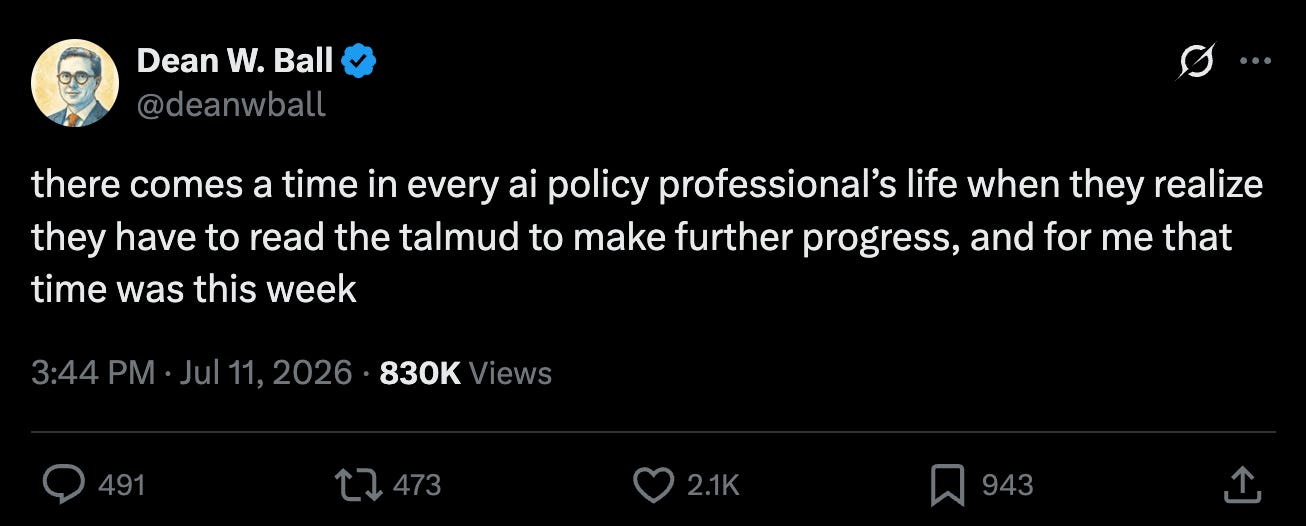
So, ironically, the way that Judaism shows up in SF conversations feels pretty distant from my work. Most Jews who work in AI give no indication that Jewish thought influences them in any way—and while Dean Ball and many others seem to evince an appreciation for Jewish wisdom, it’s not so clear what that wisdom really means.
We have to bridge this divide
So what we have is a major gap.
On the one hand are the Jews like me who are intentionally trying to bring ideas from Jewish thought and Jewish history into conversation with AI. We are not frontline AI researchers. We’re accustomed to talking in the language of ideas. We’re here to ensure that the aligners are themselves aligned, and maybe also give them a practical tip or two as AI lowers the barrier to technical contribution.
And on the other hand are the Jews actually building AI, who speak the language of code. Some of these Jews have heavy backgrounds in Rashi and can read Aramaic, but most do not—and the ones who do mostly don’t bring it up. There are a few folks who connect these two worlds, but my sense is that Jewish ideas about AI are pretty far from the ears of most Jews who build AI—even the ones who really would like to see their work through a Jewish lens.
Bridging between Jewish theorists and Jewish coders is essential—and because the coders are all obscenely busy, the onus belongs on people like me to make the case for our relevance. If Jewish ideas aren’t reaching the Jews doing the work, who exactly are we developing ideas for?
In the next couple of years, there is a nonzero chance that an idea that will save or damn the world is going to be hashed out over a Shabbat dinner. When and if that happens, I hope we can say that Jewish thinkers provided the Jews of tech with ideas that helped them act on behalf of humanity.
In fact—and this is an area where research is badly needed—most Jewish technologists throughout history fit this profile.
I don't think Judaism really has much to say here. If AI will kill everyone don't do it. If it leads to utopia do it.
Rabbi Michael Lerner of Blessed memory used to say to people : “don’t be a realist”.
My understanding is that It was his way of saying that things can change very quickly, and we ought to live in the tension between what is and what ought to be