
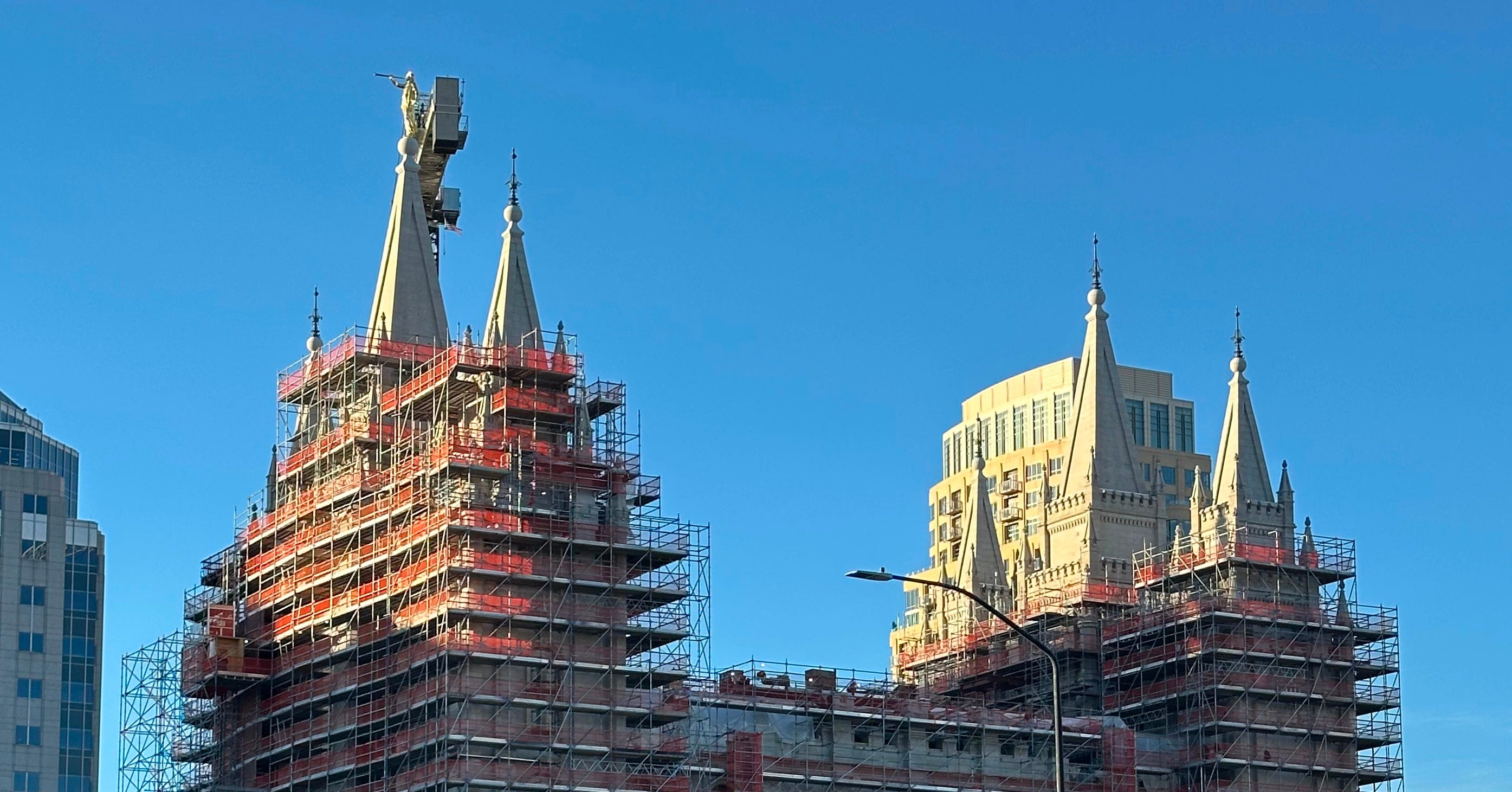
This is a transcript of a Belief in the Future episode; it has been lightly edited and there may be errors. You can listen to the episode on Spotify or Apple Podcasts or anywhere else podcasts are available.
DZ Kalman (Intro)
When people ask me which religious traditions are doing the most to grapple with AI, I give them two answers.
The first and most obvious answer is the Catholic Church, which has spent years developing relationships with Silicon Valley and building out a line of thought that recently culminated in the publication of Magnifica Humanitas, a major theological document on AI, which we talked about in the last episode.
The Catholic Church’s relationship to AI has been covered extensively in the media, and for people who aren’t following closely, I think it’s easy to imagine that all religious responses to AI are gonna look something like the Catholic response. But there’s another Christian denomination that has stood out to me for the seriousness of its engagement with AI, and that’s the Mormon Church.
Unlike the Catholic response, the Mormon response to AI hasn’t really received much press coverage. But to me, it is doing some of the most interesting work of any religion in the world.
My name is DZ Kalman, and today on Belief in the Future, I wanna tell you about the Mormon response to AI, with some assistance from one of the people leading that response, who you’ll hear from later in the show.
Now, it’s important to say, I think you should care about the Mormon response to AI even if you’ve never met a Mormon in your life. As I’ve mentioned on the show before, the things that make people anxious about AI are about the same whether you’re Catholic or Buddhist or Jewish. It doesn’t really matter. What does matter, what matters immensely, is how those religious communities are structured, because the way that people organize has a huge impact not just on who gets to respond to AI, but on the form the response will take.
Take the Catholic Church. The Church is highly centralized, which gives it a bit of an advantage when you want to say something with gravitas. The Pope’s recent encyclical, a statement about humanity issued by a church that represents about twenty percent of humanity, is a good example of how centralization is an advantage right now. But the Catholic Church is also huge, and while this means that it can throw its weight around, it also means that it has a lot of people to please. An encyclical that’s full of nuance might satisfy a truly global church. But as Brian Greene noted in the last episode, translating those ideas into policy for people around the globe is its own gigantic task, and it may take years or even decades for that response to really mature.
Another way to say this is that the Catholic Church is making exactly the moves that you’d expect a religion of its size and structure to make. But that size and structure also make other kinds of responses much more difficult. But what about religious communities with a different shape? This is where the Mormon Church comes in.
Like the Catholic Church, the Mormon Church is highly centralized, but unlike the Catholic Church, it’s quite small. At present, there are a little under seventeen million Mormons in the world, which means that there are roughly the same number of Mormons as there are Jews, and also like the Jewish people, the Mormon population is concentrated in a few places where they exert significant political power. Because of this concentration, the Mormon response to AI has been much more policy-driven than other religious responses. You can see this in the state of Utah itself, which in 2024 became the first state to pass legislation specifically about generative AI, and which has since amended that legislation and expanded it to cover things like mental health chatbots.
But the Mormon approach to AI has also involved regulating the church’s own use of AI. And these internal policies are more concrete and more creative than anything I have seen in other religious traditions. To understand what I mean, I think it might actually be helpful to list some of the policies that I’m talking about. And here, with permission, I’m gonna excerpt part of a speech that I heard at Organized Intelligence, a conference on AI that was held in Salt Lake City inside the headquarters of the Church this past fall. Just a quick note on what you’re about to hear. General Conference is the name of a convening that happens twice a year where church members can hear from leaders of the faith, and Liahona is the name of a sort of compass that’s mentioned in the Book of Mormon.
Okay, so here are the rules.
The Church does not use AI-generated images depicting Heavenly Father and Jesus Christ. Other than those approved by the Church’s Publishing Services Department, what we call PSD, and the Church’s AI working group, AI images from other sources are discouraged and are certified only in exceptional circumstances.
Those attending General Conference should be able to have confidence that all General Conference messages from church leaders are divinely inspired. Because AI cannot replace divine inspiration nor the individual work that invites it, we ask General Conference speakers not to use AI to create initial drafts or final versions of their messages.
As part of not anthropomorphizing AI, the Church will be careful not to attribute divine or human characteristics to AI. This includes the Church not assigning human names or scriptural, doctrinal, or symbolic names such as Liahona to church-produced AI tools, chatbots, or conversational interfaces.
So to recap, the Church doesn’t use AI-generated images of Jesus, it bars speakers at General Conference from using AI to write their speeches, and it carefully keeps AI at a distance from both humanity and God by not assigning AI tools human or scriptural names. Now, what I find most impressive about these policies and the Church’s other policies is that they’ve actually been passed. There are plenty of religious groups that have toyed with the idea of barring the use of AI for sermon writing or the use of AI-generated images, but actually enacting these policies seems to be a real struggle.
By contrast, the Mormon Church has been churning out these policies since late 2024, and they’re actively developing more. If the Catholic Church is a model for how religious groups can frame this civilizational turn in religious language, I think the Mormon Church is an example of how a religious community can put theological notions about AI into action, of how it can use rules to set itself apart. Now, one of the reasons that the Mormon Church can do this is that it has very well-developed systems for setting policy, for making rules.
But there’s another more human reason that the Church has been particularly energetic here. I’s hard to see unless you’re looking at these traditions up close. You see, most religious responses to AI don’t come from the top of the org chart because the people who run religious communities are not usually chosen because they love computers. Instead, responses tend to come from random pious people who just happen to be competent in AI.
Now, the Catholic Church is actually a really big outlier here. It’s not just that Catholics care about AI, it’s that the Pope himself cares about AI. That’s a really big deal. Similarly, the Mormon response to AI isn’t just coming from the pews. It’s coming from the highest echelons of the Church itself, and the man leading that response is the person whose voice you heard just a minute ago, Elder Gerrit Gong.
Elder Gong is a member of the Quorum of Twelve Apostles, which is one of the highest governing bodies of the Mormon Church. Gong’s position of formal and spiritual authority is important because while the Church’s policies around AI are quite practical, his speeches on AI are grounded in an emergent theology and a set of values that centers human agency and insists that humans should never treat AI like a god.
Like Pope Leo, Elder Gong’s writings dwell on the importance of preserving human dignity, and also like Pope Leo, his aim is to address all of humanity and not just the Mormon community. On the other hand, Elder Gong’s remarks tend to be a little bit more practical, and importantly, they’re reflective of a denomination that’s headquartered in America, sitting close to the epicenter of the AI frontier.
Look, I think it’s still far too early to say whether the Mormon approach to AI will be the most successful from an internal perspective, or whether Mormons will play a decisive role in molding AI’s impact on society at large. What I think you can say, however, is that the Mormon Church has taken advantage of its structure and size to develop the most holistic approach to AI of any organized religion on the planet.
Right now, when so many faiths are still trying to figure out where to begin, I think the Mormon example is worthy of your attention. Now, most of the interviews I conduct for the show were done virtually, but a couple of weeks ago, I had a chance to interview Elder Gong in person at a conference on AI and religion in Athens, hosted by the American Security Foundation. Here’s that conversation.
***
DZ Kalman
When I heard you speak at Organized Intelligence in fall of last year, you gave a powerful and moving speech, and there was a text that you cited connected to the Tower of Babel that I wanted to ask you about. You cited a rabbinic midrash. The text is, “If a man fell down and died, they paid no heed to him. But if a brick fell, they sat down and wept and said, ‘Woe is us. When will another come in its stead?’”
So I wanted to ask you two questions about that. First of all, what does that text mean to you in relationship to this AI project? And also because I’m interested in the kind of genealogy of ideas, where did you discover that text in particular?
Gerrit Gong
It’s interesting that the Tower of Babel is a reference example for how we’re describing some of the cautionary tales for AI. This idea of, in one interpretation, thinking that a man and technology can build to heaven, maybe even surpass heaven, is one piece of it. And in this particular Midrash interpretation, it was interesting to me that the idea that human life was less important than something about a material brick. I actually, in terms of the genealogy of the idea, I heard that when we were at an international conference in Istanbul.
And one of the rabbis there offered that as a way to think about what I had said was a cautionary tale, namely the Tower of Babel. It’s interesting that the Pope’s encyclical also starts with the contrast between the Tower of Babel and the building of a city. And so this, again, to use the term cautionary tale, this idea that somehow in our feelings about technology and the tools that we have, we need a certain amount of humility and a willingness to say we may not understand all of the implications, certainly the things that we don’t know that we don’t know, often the most important implications. I think that’s something that we need to be aware of at this time.
DZ Kalman
One thing that I find remarkable about the LDS church’s approach to AI is that you are in a position of leadership and authority, and also you care about this deeply. And not every religious denomination has those two things in the same place, right? It’s often the people in leadership are not the people who are most competent on AI. I’m curious how AI became an issue of concern for you personally.
Gerrit Gong
I was born and raised in Palo Alto in California, Silicon Valley. My father, early, was working with AI teams. He co-authored a book with a man who had co-won a Nobel Prize for his work on transistor effects. So some of this is osmosis from being a California kid. I say that in some ways we were in Silicon Valley before Silicon Valley became Silicon Valley. It was interesting to watch the process of the last many decades in that part of the world. Of course, these developments are not limited to that geography, but Silicon Valley has really been an important area of innovation on these kinds of developments.
DZ Kalman
Would you be able to tell me a little bit about the history of the LDS Church’s response to AI? Where do you locate the beginning of that response?
Gerrit Gong
I think the Church is always concerned about how the developments in the world affect the hearts and minds of the children of God. I think it’s fundamentally a theological concern for how people can now use the terms happy and forever. The plan of happiness is designed so that people can be happy, and we call it human flourishing, but for long periods of time. The developments that affect us affect us all, and are therefore of interest to the Church and its leaders.
DZ Kalman
So one of the things that I find most impressive and also distinctive about the church’s response to AI is the interest in developing internal policies. So not just developing language around values, but also implementing them. You know, when you spoke in the fall, there were a few things that you mentioned that struck me. You mentioned a number of policies that I had not heard being developed in other communities, and it really resonated with me. So, just to list a few of the things that I heard you mention: not using AI-generated images of Jesus; being in General Conference, not using AI for either initial drafts or for final messages, because these are teachings that are supposed to be divinely inspired, and you wanna kind of keep AI out of those conversations; not using AI-generated voices in church materials or using it with a disclosure; not giving AI human or divine names, which I thought was— it seemed kind of minor, but actually I find that very powerful. And I’m wondering if you can speak a little bit about, first of all, how you decided to focus on kind of concrete policy and how you think about developing each of those pieces.
Gerrit Gong
The core principles are fundamentally designed to help make sure that AI does not get between an individual and their relationship with deity, with God. And so the policy implications from that principle are the very ones that you outlined. When people come to General Conference, we want them to have confidence that the messages that they’re hearing have come from the people themselves and not from some other source. We want families to have confidence that the AI that might be used in a certain program is designed to help in the things that will allow people to be benefited, but not to insert that the AI is the revelation or the source of the inspiration.
You mentioned the question about anthropomorphism. It’s a reminder that AI is math, algorithms are math, and math is not divine in that sense. And so we wanted people to be clearly reminded that if you have a recipe that you’re getting from a chatbot, that’s informational that’s very helpful, but a conversation that might lead to a feeling that you’re in love with a chatbot or that you have a kind of therapist relationship, is a chatbot. It’s not more than a chatbot. Those very specific suggestions that you don’t give it a name, and certainly you don’t give it a name that implies any kind of theological inspiration, was intended as follow-on to that general principle.
DZ Kalman
You know, with a lot of responses to technologies, there is a moment early on in development when it’s actually easier to create policy because the technology is not fully developed. People have not fully acculturated to using it. And then as the technology develops and people can’t really imagine life outside of it, it becomes harder to actually develop those policies.
So I’m curious how you imagine these policies kind of growing and developing as the AI systems, which already seem quite real and already seem quite human become even more so. How do you think about potential criticism from within the Church around these policies? And, and part of the reason I’m asking about this is because I see in many religious communities, there is a kind of hesitance at exactly the point of going from theoretical to practical, right? We can talk about the principles that we care about, but we are really worried about alienating people when it comes to actually telling them what to do. And at the same time, if you don’t tell people what to do, they’ll feel like, “Well, where’s the leadership here?” So how do you think about that balance?
Gerrit Gong
It’s such a great question. Our fundamental feeling is, you teach correct principles and let people govern themselves, and therefore the onus is in trying to understand what are the timeless elements of those things that seem very timely. And so the question of how you decipher and decide and discern the principles has to be done within the context of today, tomorrow, a year from now. Of course, as the principles need to be adjusted slightly because the technology’s changed, that’s always an option. But you want to define them as best you can in terms of their long-term consequences. So, for example, we’re very focused on the promotion and protection of individual moral agency and the idea of enlarging capacity, not constricting it. We’re very concerned that people learn always to do their own work, that we learn by doing things, including things that are sometimes challenging. Recently, in the conversations we’ve been having over the last few days, we’ve been talking about frictionless relationships. And part of the challenge with so-called frictionless relationships are the things we need to understand and learn by our experience and mortality are the so-called frictions. It’s the things that we invest in because we are concerned and love people, the so-called frictions, that actually are the most important parts of what we’re doing. So the question of how we discern the principle that then brings the policy is done with an eye to trying to say, “What will be long-term?” True, the fundamental values in terms of the things that we think will be beneficial. That’s been the approach.
DZ Kalman
Yeah. Let me take it to a different place. Within Jewish conversations around magic, not recently but historically, there’s a kind of famous debate between the rabbis Maimonides and Nachmanides, Rambam and Ramban. Neither of them like magic very much, but they disliked it for very different reasons. So Maimonides didn’t like it because he thought it was fake, it was illusory, and people shouldn’t be spending their time on illusory things. Nachmanides, on the other hand, didn’t like it because he thought it was actually entirely real, but it was inappropriate. It was a way to affect change in the world that was intentionally barred and was problematic. Thinking about this in relationship to artificial intelligence, you know, I see kind of criticisms of artificial intelligence that kind of go in both directions: AI being problematic because it presents as something that it is not, or AI being problematic because it is real in some way. It is doing something that is genuine, but its realness is problematic. And I’m curious how you kind of see the problems with AI on that spectrum. Is it more an issue of being illusory, or is it being, real but dangerous?
Gerrit Gong
It’s called artificial intelligence because there’s some elements in it that are artificial, and it’s called intelligence because there are some elements in it that reflect a capacity to do particularly cognitive kinds of skills. The question of how we discern real and unreal in human relationships that are affected by AI is precisely the kinds of things we’re looking at. I’ve thought about it in terms of four kinds of relationships. There’s the relationship with the thou; there’s a relationship with the I; there’s a relationship with society, which is the they; and the relationship with the natural world, which is the it. And there are some elements in all those relationships which are what we would call real or authentic, and there’s some which are in some ways distorted potentially, and in other ways accentuated, by artificial intelligence.
And so we’re at a point in time when we’re trying to discern which elements are authentic, which ones can be distorted. You think of it as a black hole in the sense that it can distort gravity. This in some ways is a technology that can do that. It can change perception. In some ways, the existence of some things depend on how it’s recorded and the weights in different kinds of AI models. So we have to be very careful about what we think is real and not real, what is long-term, which is ephemeral, what has separate existence versus maybe not having existence. So that set of questions is really why AI is such an important element for us now.
DZ Kalman
I wanna go back to something you said about people having relationships with artificial intelligence, and many of the policies that you’ve spoken about seem intended to make sure that people do not get confused about what it means to relate to a person versus relating to a machine. At the same time, there is a movement, there is a school of thought, including in some AI companies like Anthropic, to imagine AI as being a person in some way. And it’s a little bit hard to tell sometimes—that seems to be used as a kind of heuristic just for purposes of developing the machine, but it also seems like there are some people who genuinely do believe that AI is, either now or in the future, would deserve some kind of moral status, may be sentient, may be conscious. So do you think AI could ever be deserving of moral status?
Gerrit Gong
We talk about AI personas. We talk about AI personas perhaps having personality. They react differently depending on how they’re treated and discussed. At the same time, I think we need to be quite clear about the differences with human intelligence or divine intelligence and artificial intelligence. So I think that’s a set of questions that we’re gonna continue to think about in the upcoming period. But to me, some people speak too glibly about AI being God or becoming God or godlike AI. AI is not God and cannot be God. God created man, man created AI. AI cannot and will not be God.
DZ Kalman
So I find that very powerful, and I think I agree with you. The other theologically-laden language that I’ve seen around AI is, AI as humanity’s child, that AI is created in our image in a way that we are created in the divine image. Now, I should say that’s a language that I have also seen at Anthropic, right? The idea that in a sense they’re raising this new and very powerful and, you know, quickly growing child, and that they have a kind of responsibility to it and perhaps have an obligation to it in the way that a parent has an obligation to a child. What do you think about the language of AI as humanity’s child?
Gerrit Gong
I think that’s a metaphorical language, and I think it’s the case that people want to recognize that AI is being developed. It’s not simply all of a sudden instantly in place. It’s something that’s developed over periods of time through training, and it takes that training and uses it in sometimes unexpected ways. But I think we have to understand that’s a metaphor and not necessarily a description of the kind of relationship we would have with God or we would have with our own children.
DZ Kalman
What if AI is theologically significant? What if creating something that is so similar to us actually does provoke in us or does kind of consistently present to people a sense of, we are different or we are greater than we expected? Is there a place to incorporate AI into theology, or does that need to be resisted at all costs? Or somewhere in the middle? Sorry for presenting it so starkly.
Gerrit Gong
When you say represented in theology, I’m not sure if you mean some kind of moral standing in theology, or whether it’s something that has to be part of doctrinal or theoretical theological consideration.
DZ Kalman
To clarify, thinking about the kind of the genealogy of religious responses to AI, I remember a number of years ago, I interviewed Jason Thacker at a Southern Baptist Convention’s think tank, and he talked to me about how one of the things that provoked his interest in developing the Southern Baptist response to AI was the fact that he read Yuval Noah Harari writing about the future of humanity and us becoming godlike. The fact that Silicon Valley and the technology folks were themselves using kind of religious language because the products that they were developing were so powerful that it seemed like they kind of naturally fell into it. So this seems like a technology which is so powerful and makes us question what it means to be human, that framing it in religious terms seems almost unavoidable. Even folks who might have characterized themselves as being entirely secular seem to be interested in using religious language around it. So because of that, it seems like there might be a place for AI to have some kind of theological significance, or it may be something that kind of keeps coming up. So I don’t have a specific idea of what that would look like in mind, but it seems like a question that I can imagine people continually trying to develop. Like, what would it mean to put AI into a theological context?
Gerrit Gong
Maybe we come back to the Tower of Babel and the idea that a powerful man-made technology can cause us to ascend towards heaven. I would suggest that we maintain a certain humility in recognizing that no man-made creation will be God. God is God. We were today at Mars Hill, and it was a reminder that in the midst of all of the accomplishment that you could have imagined in Greece at that time, the inscription was to the unknown God. And somehow, in the midst of all the accomplishments—and they’re genuine accomplishments, many of them come from God with inspiration—we don’t lose the fact that God is God. And that He is father to us all. He’s not distant, he’s not unknown, and his relationship is of God the Father to us as his children.
DZ Kalman
How do you think robotics changes things? Right now, one of the key distinctions between AI and humans is that AIs do not have bodies, or at least bodies that we see, right? Maybe they exist in server farms somewhere, but they’re not embodied. And certainly within theological context, the fact that the human body has theological significance in and of itself really matters. We may only be a few years away from a world in which there are embodied AIs all over the place, you know, maybe even AIs that are intentionally shaped to look like human beings. How would that change your thinking, or how would you respond to a world in which there are these embodied AIs in our environment at all times?
Gerrit Gong
I think we’re already closer to that than many people would think. The fact that we have advanced robotics which converge with AI technology are going to make the separation which we’ve heretofore had between the kind of the world of the mind and the world of physicality come much closer together. We went recently to see the robotics in Silicon Valley and they’re elsewhere. The same distinctions that we have for AI not in a robot, and in a robot, will still be the same.
DZ Kalman
You wrote recently, “Of course, we need essential AI guardrails, but neither in humans nor in AI can agentic capacity be constrained into promoting the greater good, only by do or do not guardrails. AI personas need reasons, not rules.” Can you expand a little bit more on what you mean by that?
Gerrit Gong
I felt very strongly that neither in AI nor in people can you end up with the desirable long-term outcome simply by constraint. You cannot constrain someone or an AI into something which is long-term beneficially, and that’s why we’ve talked about the need for moral compass and the gift of possibility for AI, because we need to constrain the clear cases where there could be catastrophic harm. But simply constraining the catastrophic harm doesn’t move us in the direction of all the possibility for good that we need to have. And so the gift of possibility is to say, let’s try to find the ways that our AI personas can be both good and effective. And that, to me, comes from having the case studies and the examples which are the very best, most admirable traits. There has to be some persistence for the character to have judgment and for the judgment to have a moral core that leads us into the direction that is the best of human flourishing.
***
DZ Kalman (outro)
Thanks for listening to the show. As I mentioned at the top, the Mormon response to AI is particularly robust and is developing quickly, so we’ll probably return to it later in the season. This episode was edited by M. Louis Gordon, and our production manager is Misha Holleb. Belief in the Future is produced in partnership with the Faith Family Technology Network and is a production of Sinai and Synapses. Funding for Belief in the Future comes from the Templeton World Charity Foundation. Also, if you’re looking for a transcript of this show, you can find one on my blog, jellomenorah.com. That’s all for today. See you next week.