
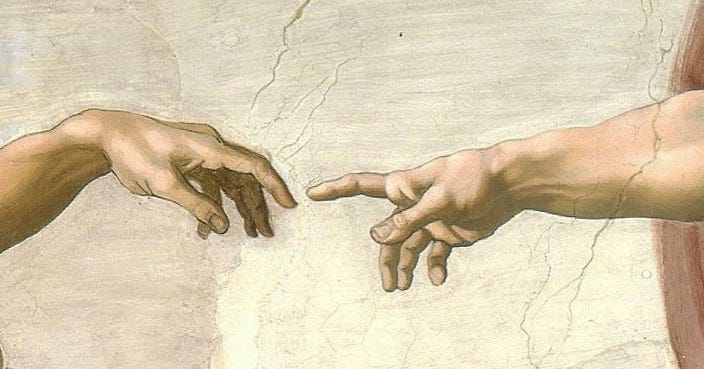
In the twelfth century, the Jewish philosopher Maimonides made a major theological claim: You can’t say what God is. You can only say what God isn’t. In his words:
Know that the negative attributes of God are the true attributes: they do not include any incorrect notions or any deficiency whatever in reference to God, while positive attributes imply polytheism, and are inadequate, as we have already shown.
Why is it polytheistic to use positive attributes? Because any attribute you choose ends up diminishing God. I can say “God is wise,” but surely wisdom isn’t everything that God is. Worse: There are wise things that are not God. Are you saying that those non-gods share something with God?
Instead, it’s logically safer to do the opposite. God isn’t wise, or kind, or tall, or even merciful. God is just God.
Maimonides isn’t the only one to hold a version of this view. Negative theology—also called the via negativa, or apophatic theology—was professed by some Christian and Muslim thinkers, as well. It isn’t a great theology if you’re Michelangelo and want to put God in your paintings, but it has an elegant internal logic. I get the appeal.
Unintentionally, I think we have created a negative theology of AI.
To be clear, nobody did this on purpose; it’s just that we’re much more comfortable saying what AI isn’t than what it is. Here is a list of things that people have recently said AI is not:
AI is not God
AI is not human
AI is not a person
AI is not a child
AI is not a friend
AI is not a slave
AI is not an animal
AI is not just another tool
The people who make these denials, you may have noticed, are quite sure of themselves. They are almost always less certain of what AI is. Positive declarations are quietly pushed to a later day.
The irony of this approach, of course, is that it makes AI seem more godlike—for what other being in the universe is so mysterious that it can only be described by negation? By refusing to offer a clear, convincing argument for what AI is, we only boost AI’s mysteriousness. Its ineffability, so to speak.
In other words: if we don’t say what AI is, it becomes a god by default.
We put ourselves in this mess
We got here for two reasons:
It is genuinely hard to find words to describe what AI is.
There are strong social disincentives to being decisive in an affirmative direction.
I will deal with the first point at the end of this post. With regard to the second: Imagine that Anthropic declares tomorrow that AI is a person, or even that it is conscious. Or imagine that the Vatican says that AI is just a fancy calculator, and that any resemblance to humanity is meaningless. Either one of these affirmative statements would produce immediate and severe blowback (though Anthropic’s would likely get much more) because neither captures the public’s intuitions or concerns about this technology. Most people do not think AI is conscious—but they also think you shouldn’t lie to your chatbots or make them do things over their protests. Also, their attitudes seem somewhat dependent on how the AI presents itself and whether it is embodied. Also, the Chinese public is much more open to AI consciousness.
Saying what AI is not is good for coalition building. People of faith love it when a religious leader says that AI isn’t a god, for example. But making affirmative statements about AI’s ontological status will alienate at least some of your friends. Worse: You’ll probably be labelled a heretic. In a sense, this would be correct. The word “heresy” comes from the Greek hairesis, which means “a choice.”
But—as Peter Berger wrote in The Heretical Imperative—choosing isn’t really a choice anymore. Liberal society allows for a vast diversity of thought. You are always a heretic to somebody.
Deciding, affirmatively, what AI is (or ought to be, since we still do have some say in building it) will necessarily be a complex, fraught task. I’ve been watching religious groups talk about AI for years and I can see them struggling at the edge of this question.
And yet: It could not be more important. If the technology remains ineffable, our civilization’s response to it will be incoherent. Everything flows from ontology. We need to do this hard thing.
Describing AI is genuinely difficult
Make no mistake: It really is hard. Despite the fact that AI is unprecedented, we seem to be having a hard time coming around to a clear and obvious truth: We do not yet have language for what AI is. As I said, it’s unprecedented. Why would we have language for something unprecedented?
The truth is: AI is something new. It may not be God, but it’s also unlike anything humanity has encountered thus far. We can compare AI to people or animals or tools, but all of these comparisons fall short. AI is its own thing; nothing in human history has perfectly prepared us for it.
This doesn’t mean we can’t say what AI is; it just means we need to be open to it being something new.
Ironically, this experience of finding language for the new does have a precedent: becoming a parent. When my oldest child was born, we didn’t have language to describe him. We’d say that he had his mother’s eyes, or his father’s smile, or his grandfather’s ears. We didn’t know him yet. But kids aren’t an amalgamation of the people they resemble. They are themselves. It just takes a while to figure that out.
(Unfortunately, AI isn’t actually a child and the analogy breaks down here. We don’t choose how our kids will come out, but we have a lot of power over how AI develops.)
We can only solve this problem together
We’re never going to reach consensus on AI’s status, but we can do our best to prevent our discussion of this issue from devolving into violence. (What discussion of status has not involved violence?)
The key question is: What will it take for the public to trust the answer?
I don’t know, but this question occupies my waking hours. I am trying to figure it out, and I am lucky to be in community with others who are thinking along similar lines. I know that it will require a broad coalition, and I know that faith communities and tech companies need to play a major role. Despite having successfully secularized the notion of human dignity, religious groups continue to play a major role in helping the public respond to new moral problems. If a choice needs to be made, the nascent bond between faith and tech can help them make it. It would be the ultimate fulfillment of their partnership.
One thing is clear: whatever the process, it would (fittingly) be unprecedented in human history. If AI is the ultimate expression of our creativity, successfully helping humanity determine its status would be the ultimate expression of our moral discourse.
If you want to help build this, let’s talk.
I don't know why you can't say it's a simulated digital person with access to a vast store of knowledge and analytical ability that only communicates through language. People's instincts are irrelevant - they are largely projecting themselves onto entities they recognize as similar to themselves. This may be a good idea but it has no bearing on what AI is.
AI is software. It is typically many matrices being multiplied many times over using the same hardware as many other kinds of software. It is certainly powerful--maybe unprecedentedly!--but can you say more why you might think this characterization is insufficient? I don't want to gloss over the ethical questions you raise, but I think we potentially overcomplicate the matter if we don't relate to AI as fundamentally software.