
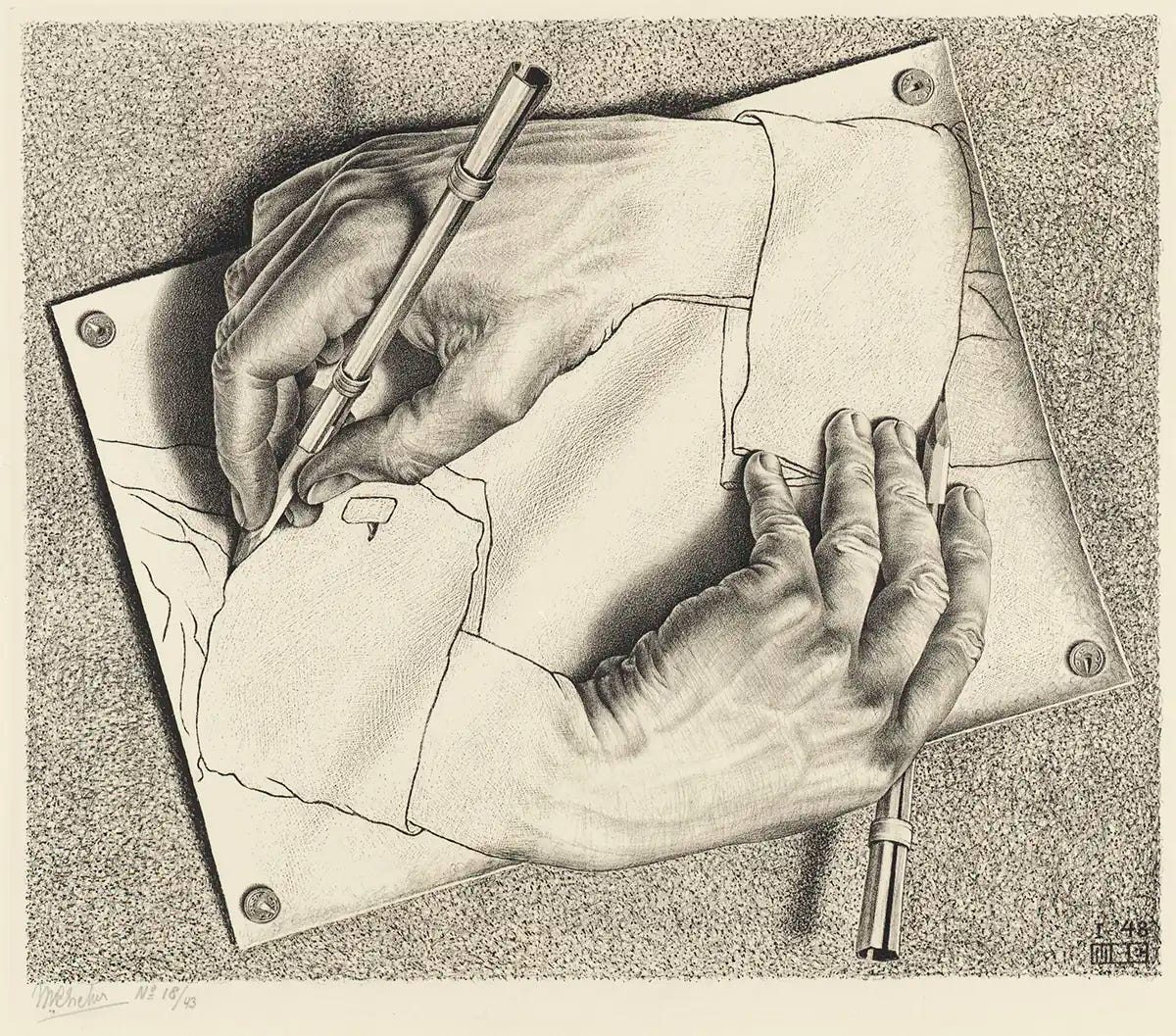
I tried, reader. In the weeks leading up to the release of the encyclical, I really tried to get the pope on my podcast.
He didn’t, obviously—and hey, if you’re reading this: No hard feelings.
But as I was pinging my connections, I was informed that he probably wouldn’t do it not just because “seriously who do you think you are” but because you’re not really supposed to dig into the authorship of an encyclical in the first place. A major statement like this isn’t supposed to feel “authored”; it simply comes into the world, fully formed. The document loses some sparkle if you picture a draft sitting in somebody’s Google Drive with a bunch of comments in the margins (or worse, magnificahumanitas_final_final_REALLYFINAL.docx). It emerges from the church, not any one man.1
But this document has a specific authorship problem because there are good indications that one of the voices that contributed to its formation was AI itself. Others have already done analyses that strongly suggest this, and if you’ve read enough AI prose you can simply smell it.
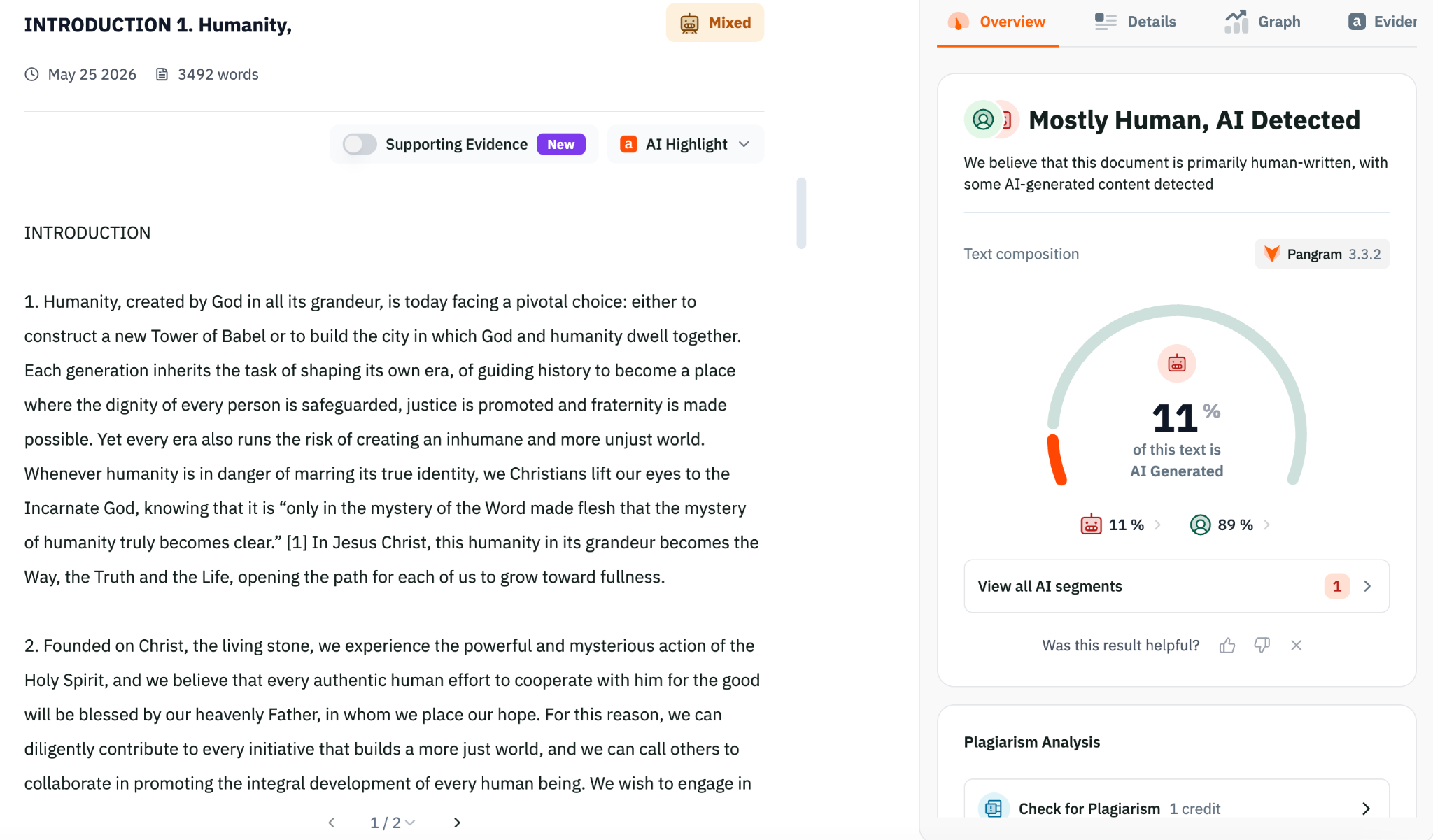
What are we supposed to do with this? What does it mean?
It certainly means something. AI may be “just a tool,” but even as a tool its utility stems entirely from its ability to speak as we speak, act as we act, and think as we think.2 This is not a byproduct of its function; it is the function. Pretending otherwise is like pretending that it’s a happy coincidence that a drill can make holes.
In the face of this unprecedented resemblance, the document is attempting to reify humanity’s unique place in the cosmos and unique relationship to God—and, crucially, to differentiate humanity from this simulacrum it has chosen to fashion.
But that simulacrum has apparently played a role in writing theology for us—and since the pope himself has already sharply criticized the use of AI in writing homilies, this really leaves us3 with only three choices for what to do next:
Downplay. We can tell ourselves without evidence that it only contributed style and not substance.
Say sorry. We can see it as a human flaw in a human document (borrowing the pope’s own language, the authors have given into “temptation” by using AI).
Bite the bullet. You can read AI’s intrusion as theologically meaningful.
The first option is wishful thinking. We’re never going to know how AI was used here—and in any event, you can’t really separate style and substance in a document whose persuasive power is tied directly to its style (in Judaism, I’ve called this the problem of eternal Purim Torah).
So we really only have two choices: was this an error that a better-organized encyclical would not have had, or do all those em-dashes and distinctive sentence structures (and maybe some novel ideas) bear theological meaning?
I think there’s only one good answer, but let’s play this out step by step.
Resistance is futile
There have been some scattered efforts to keep AI out of religious missives. I have argued that rabbis should not use it for sermon writing. The LDS church has excluded its use for writing drafts of General Conference talks because listeners are supposed to understand these speeches to be divinely inspired.
Crucially, the pope himself has discouraged the use of AI for sermon writing, though he has not formally banned its use. A National Catholic Reporter article from a few months ago described his remarks:
“Like all the muscles in the body, if we do not use them, if we do not move them, they die. The brain needs to be used, so our intelligence must also be exercised a little so as not to lose this capacity,” Leo said in the closed door meeting, according to a report by Vatican News on Feb. 20.
“To give a true homily is to share faith,” and artificial intelligence “will never be able to share faith,” the pope added.
We’re all saying the same thing: AI may be good at writing religious messages, but using it in these contexts will degrade an essential pastoral skill—and worse, it creates confusion about what a sermon is supposed to be. You’re not just trying to do some clever readings; you’re trying to be a human talking to humans about the divine. You don’t really want to bring AI into that relationship. The origin of the words really matters.
But most religious traditions have said a lot less—in fact, I’d rate my own proscription as the most severe out there, with the Mormons (who can actually enforce things) in second place. Most of the world’s faiths have remained pretty quiet on this one, and there are two pretty obvious reasons why:
It’s scary and risky to tell people what to do, even if they’re your own clergy. Most religions are anxious about retaining followers.
It’s mostly unenforceable. All you really have is the power of persuasion.
That second piece really matters. The encyclical contains AI because everything contains AI. I can resist using AI in this post because (1) I’m one guy, (2) this isn’t very long, and (3) I like writing,4 but a 40,000-word collaborative text is going to have AI unless you go to great lengths to exclude it—and the Catholic church’s pre-encyclical theological position on AI was (ironically!) not sufficiently developed to justify excluding AI from encyclical composition. Maybe they should have started with that rule instead.
So now, there’s that choice again: Do you say that this was an error (the encyclical does cherish human fallibility, after all) and make a stricter policy for future missives? That’s a reasonable choice; South Africa just withdrew a draft policy on AI use after it was discovered that AI wrote much of the policy (and badly).
But I don’t think this is the way forward. I don’t think it’s sustainable, either logistically or theologically.
Instead, I think there is really only one path. It’s probably going to make you uncomfortable, but I think it is basically unavoidable.
AI is not a secular technology
“AI is not and cannot be God.”
This concise framing by Gerrit Gong, a leader of the LDS church, has been echoed across most of the world’s religious traditions. The “no AI gods” framing neatly encapsulates so much of what religious leaders find problematic about AI: the idolatrous hubris of the tech sector, the overconfidence in AI’s omniscience and power—and, of course, the explicit “we’re building god” framework that AI firms themselves sometimes adopt.
So, ok, AI isn’t god. But theology isn’t just about god; it’s about relationships with god. And—well, we’ve invited AI into that relationship. Maybe we didn’t mean to, but we did. We invented a machine so shockingly similar to us that it brought secular and faithful alike back to questions about the nature of humanity—brought tech giants to ponder the theological meaning of their actions. AI is a religious technology. Why, then, have religious folks been so adamant in neutralizing its religiosity? Why must all of this grandeur be reduced to the shape of a calculator?
How long can we reasonably say this is meaningless? There are vast, beautiful stories to tell about a humanity that has reached so deep into its wellsprings of creativity that it has found a way to recapitulate some essence of itself in silicon. Certainly, artificial intelligence and human intelligence are different—but we do a disservice to our own kind when we wave away all the beauty that AI can create as nothing more than an optical illusion. Does this not simply dishonor the human condition?
Yes, we should be afraid of telling theological stories that deify technologies or their creators. But theology can’t be driven by fear of telling the wrong story; it needs to be motivated by a desire to tell the right one. And embracing the right story can be just as much of a defense against danger as rejecting the wrong story. Remember how I talked about religions co-creating the future? This is part of what that means.
AI helped the pope articulate the nature of the human person in the age of AI. What if this partnership were just as meaningful as the one between God and humanity, a similar partnership of beings that are both like and unlike?
What if the entirety of our theologies were preparation for just this moment?
Should you listen to this Jew?
Now there’s a big flaw in this argument: I’m Jewish. Maybe I’m a “person of good will” to whom this encyclical was directed, but I’m certainly not in a prime position to criticize a Catholic document.
Perhaps there is something in my Judaism that pushes me in this direction. The curmudgeonly theologian Yeshayahu Leibowitz (1903–1994) once wrote a strange letter to his colleague Norman Lamm on the theological meaning of extraterrestrial life. Leibowitz wanted to know: why would this be a problem? God is special; humans are not.
Planet Earth has no advantage over any other part of the universe. Humans have no innate advantage over any other living creature. It is only serving God that grants humanity a special status, which does not depend on the structure of the universe or the nature of life and humanity. …
Here lies one of the profound contradictions between Judaism and Christianity, for [in the latter] divinity was made incarnate on Earth in human form and hence the unique importance of humans and of planet Earth. Whereas our God “is not reached by physical properties” (Maimonides, principle #3) and “the world is not God’s place, but God is the place of the world” (Genesis Rabbah 68:9). Christianity is anthropocentric; Judaism is theocentric.
Leibowitz may be overstating the difference, but I feel the point strongly. In both Judaism and Christianity, humans matter because they are created in God’s image—but in Christianity they also matter because God was literally incarnate in a human body. The former allows for the possibility of a genealogy of holiness: God to human, human to AI. Incarnation, on the other hand, sticks to people.
Without that stickiness, chutzpah flows in. The rabbis of the Talmud imagined themselves as grown children, writing theologies so astoundingly radical that God could do nothing but proclaim “my children have defeated me, my children have defeated me.”
Of course, they wrote that God said that. Theologies aren’t monologues; they are joint productions of all interested parties. Humanity’s magnificence exists in relation to all that surrounds it—above and below, inside and out, past and future.
Have women ever played a role in the authorship of encyclicals?
To a point, of course—but I have no confidence that we know what that point is, and neither should you.
By “us” I mean readers who care about faith-based statements on AI, but of course I am not Catholic and so my ability to criticize is limited.
And actually I did use AI for research, though not for drafting.
I don't see a problem with the use of AI to construct theology - despite the rich irony when that theology aims to circumscribe AI's boundaries.
But you lost me here: "What if [the human-AI] partnership were just as meaningful as the one between God and humanity, a similar partnership of beings that are both like and unlike?" If AI creates not just a difference in degree (of intelligence, human expression, work output etc.) but in type (standing alongside the God/human relationship which defines what makes humans unique and worthy of human rights) , then you may have crossed over into the transhumanist embrace of AI. Not sure there's a middle ground. What else would that ‘unlike’ be?
Very interesting! I also personally only use AI for research but not for writing.
I think the future will (somehow) skew back to valuing human-human interactions, after the internet becomes consumed with AI content which humans can no longer discern from human content (that's already happening at a pretty rapid rate). At least sermons have a delivery. But content that only exists online (as its medium for delivery and consumption) does not have a bright future.