
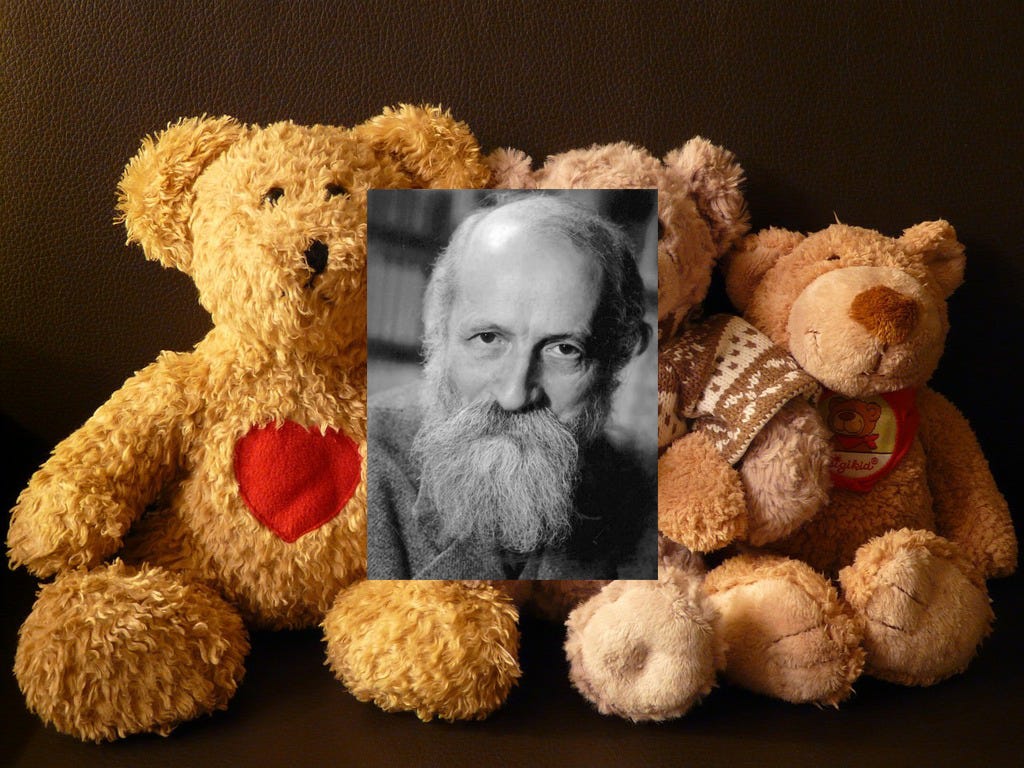
A few months ago, on the day before Passover, my youngest son had an emergency appendectomy. As you might expect, neither I nor my wife was allowed in the operating theater, but luckily my son wasn’t alone. In the room with him, together with the surgeon and the anesthesiologist, was Guy. When we saw my son again in the recovery room, Guy was already there waiting for us. Guy is one of my son’s oldest friends, and the rest of my family adores him too.
On most nights my son will go to sleep with Guy cradled in his arms. And when we can’t find him at bedtime we’ll search high and low. It’s genuinely hard to imagine my son without Guy. The two are inseparable, and there’s something beautiful about that.
This is a transcript of a Belief in the Future episode; it has been lightly edited and there may be errors. You can listen to the episode on Spotify or Apple Podcasts or anywhere else podcasts are available. I’m including links to sections below for easier navigation.
As you’ve probably guessed by this point, Guy is not a person. Guy is, in fact, a small stuffed penguin that we bought at an aquarium in Istanbul a few years ago. If you’re a parent or had a favorite toy or doll as a kid, you know that these relationships can go really deep, and that relationships really is an appropriate word to talk about how we think about these objects.
I’ve been thinking about Guy, the stuffed penguin, recently because of our ongoing societal debate about how we relate to AI and the many people who already turn to AI regularly for therapy, for friendship, even for romance.
I think there are legitimate concerns about all of these relationships, especially when they lead people to self-harm or to shut out real humans in favor of the frictionlessness of AI communication. These behaviors are especially concerning when we’re talking about kids, because it’s hard to develop a sense of self if your best friend is just a mirror.
But I don’t think it’s so simple, and Guy is a good example of why. Sure, it’s important for humans to have relationships with other humans, but humans also have deep relationships with all sorts of things, and those relationships are not just illusions. Love for a dog can be real. Love for a car can be real.
You can have a relationship with a couch or a piece of clothing, or even an entire city. None of these things will ever converse back to you, but that doesn’t stop us from relating to them. So I think there’s a real question here. If I can have a relationship with a stuffed animal, who’s to say that I can’t have a relationship with Claude or ChatGPT?
To answer this question, I think we need to talk about Martin Buber, an important twentieth century religious thinker and philosopher whose work is directly relevant to the present moment, but it really has not received enough attention. Buber was born in Vienna and died in Jerusalem, and his work covers a remarkable variety of topics, from Zionism to Hasidic thought to psychology to post-Holocaust theology.
But Buber’s most popular work is I and Thou, which is about all the ways that we can form relationships, including relationships to things that can’t talk back to us. To help me connect Buber to AI, I spoke with Dustin Atlas. Dustin’s a professor at Queen’s University in Canada, and he’s the author of How to Talk to a Cat: Buber, Philosophy and Dialogue with Unspeaking Things.
This is a book that’s not about AI, but it also clearly is about AI, and I found the conversation really moving, and it really unlocked for me a new dimension to our conversation about AI relationships. I think it’s an important missing piece to the puzzle.
***
Who Was Martin Buber?
DZ Kalman
So who was Martin Buber?
Dustin Atlas
Martin Buber is a Viennese Jewish philosopher. Translator. A lot of things. I mean, he had money and he had ability. He was a theater director. But yeah, I would say he’s one of the major Jewish thinkers of the 20th century, especially when thinking about how we can sort of save elements of religion in a kind of contemporary, liberal, technological universe.
Talking About Versus Talking To
DZ Kalman
So within the context of AI, I think the book I and Thou is maybe the entry point or the front door to Martin Buber. It feels strange ’cause, you know, as you described, Buber has a really diverse personality and portfolio and a realm of things he’s thinking about, right? He’s thinking about Zionism and, you know, Chinese aphorisms.
But I think I and Thou is how people often know him. So what is this book, and is this a work of philosophy? Is it a work of religion? How do you think about it?
Dustin Atlas
Basically, I and Thou is a book that says that there’s sort of two different ways of thinking. One, I can think about stuff, and one, I can think with stuff.
One, I can talk about stuff, one, I can talk with someone. And Buber wants to bring into focus the talking to as the sort of central issue of the text. I can know all about you and everything about you, but if I’ve never met you, something is missing. And it’s really hard to say what that something is because you can’t really say it’s experience or knowledge or I’ve seen your hair color, because those are things that are about you.
So the claim is that, like, when I talk to you, something different happens than when I talk about you, and that that something different is extremely difficult to capture because whenever you talk about it, you’re out of the room, right? So for Buber, this talking to is essential, and it has no real content in the way that talking about does.
So if I talk about you, I can talk about your glasses, your beard, your bookshelf. I can make inferences from your books as to what person you are or wanna be. And then when I talk to you, I have to kind of let all of that go to a certain extent. And the I/You moment, which is really famous, is where I let all of that go, and the only thing that sort of exists is just this relationship between us, and everything else appears in the context of that relationship.
DZ Kalman
And for Buber, does that happen every time you talk to someone? Does it happen intentionally, unintentionally?
Dustin Atlas
So no, you don’t have that much control because there’s two people in it, and I can’t control you. I can’t make you do anything, right, in this sense. And in fact, if I try to make you do stuff, I’m using you as an object, so I’m instrumentalizing you, which is not always a bad thing.
But it means that we’ve definitely left that. So he says it has to be a combination of will and grace, referencing the TV show, obviously. And so people who try to force a dialogue, which you see a lot, frankly, in contemporary institutional settings, for this is very un-Buberian. You can’t make someone dialogue if they don’t want to.
That itself is an anti-dialogical sort of position. So no, it doesn’t happen all the time. It also doesn’t happen by magic. But he doesn’t seem to be exactly clear about what you have to do to cultivate a dialogue. This isn’t something he spends as much time on as, as I think many of us would like.
He also thinks these I-you relationships can happen with anything and out of the blue and at any time. It can happen with a machine you’re using. It can happen with food you’re preparing. It can happen to a tree, a cat, you. Humans are probably the easiest, but for him, these sorts of relationships of directedness can happen anywhere and with anything.
How to Meet a Tree
DZ Kalman
Okay, so let’s start with trees. I know there’s a famous passage in I and Thou about trees. He talks about, you know, considering a tree, looking on it as a picture, a stiff column and a shock of light, a splash of green shot with a delicate blue and silver of the background. Like, he’s a beautiful writer. I think we should say that about him.
Dustin Atlas
It’s an important part of who he is as a thinker. You can see perceive its movement. Like, there’s all the kinds of things that you can say about the tree, but that’s not quite the I-You engagement.
Now, meeting a tree is tricky ’cause a plant doesn’t have a sense of an individual being, either itself or somebody else’s.
And what’s important to just, to slow down and move back a step, when he gives a list of things I can say about the tree, they’re not all sort of techno scientific. Some of them are like, “It’s beautiful. I can do an impressionistic understanding of the light.” So the I-you relationship is not positioned against either science or romantic or adoration or tourism or anything.
It’s positioned against sort of everything, like literally anything that is a thing. And so with the tree in particular, you have to just really be open and wait until something happens for him, because you cannot in any way hurry a tree along. And this sort of emphasis on kind of openness is particularly evident with plants or rocks or things that are not alive at all.
In fact, I’m sure he had not, when he wrote the book, completely worked out what the deal was with plants. And you see this because immediately people are even, like, sending him letters like, “What is going on with the plant thing? I’m trying to teach this, but then I get to the plants. This seems ridiculous.”
For many people, it’s an excuse to not take him seriously from that point on. But I think he’s onto something, which is that there is a way I can relate to a tree that mimics the second person you in conversation, even though I can’t talk to the tree. I mean, I can talk to the tree, but it’s not gonna talk back.
DZ Kalman
I’m curious if you’ve ever had an encounter that resembles what he’s talking about, either with a tree or some other inanimate object, and if you can describe it.
Dustin Atlas
Yes. Yes. I don’t like to talk about it, though, because my parents are hippies, and I try to avoid any sort of hippie-ish type of affectation.
Yeah, but particularly for me, tools and handcrafting things is an easier space for that. And then I had a cat for twenty-two years, and yeah, we definitely—and we traveled everywhere, and there were years where the cat was really one of my only companions. And so yeah, I developed a fairly relational relationship there.
I think that’s more sort of normal if you think people understand a pet. But I mean, I have a knife that I was very attached to, and I felt like I could communicate with it. Like a whittling knife, not like a scary knife. And food is another one. Like preparing food, I will often feel like I’m in a kind of strange relationship with the vegetables and things I’m working with.
Buber’s claim is that literally if you can sense it, you can have a relationship with it, but that most of the time you won’t, right? The vast majority of our relationships are unobserved, unnoted, and that’s a good thing because otherwise you would just be constantly exhausted by this sort of number of things calling on you at all times.
Why Every “You” Becomes a Thing
DZ Kalman
Right. So my sense is that for Buber, there is this kind of constant fluctuation between being in relationship to things that are mostly just things, including people that are things, and every once in a while, there’s this little spark, and it becomes a you. But he says in “I and Thou,” he says, “Every You,” capital Y, “every You in the world is doomed by its nature to become a thing or at least to enter into thinghood again and again.”
So you’re doomed to go back into this state. Is the idea that, you know, a good life or a better life is one in which a higher percentage of my time is spent in the I/You state where I am in that full relationship, or should I just accept that this is how life is gonna be?
Dustin Atlas
I would be very wary of trying to time these relationships. I think if you don’t have them, he’d say that’s a really poor existence. And if, for instance, you only have relationships with humans, that’s a fairly narrow existence, although maybe a much richer one. I think two things are important here. Like, we don’t fall out of the you relationship because we’re weak or finite or it’s not a failing.
It’s that in order to make this relationship real in the world, we have to turn it into a thing. And so if I don’t end this you, it actually becomes unreal. So actually, part of the relationship requires that it becomes a thing. It’s not a function of limitation or finitude. It’s because that’s how it becomes real.
It becomes real by ending. The other thing I wanna note here is I privilege, at least in my own work, dialogue over the I-you, even though they’re often viewed as the same thing. So dialogue, you can come in and out and in and out, and it’s sort of therefore a bit more normal and like day to day than the I-you.
The I-you has something special about it that dialogue in a way doesn’t. So I mean, I may have I-you relationships with my wife occasionally or anyone you’re in love with, but you can’t sustain it, and it’s actually undesirable to sustain it. You want to be able to step in and out and back and forth and get bored sometimes and other times be enraptured.
And so dialogue is a sort of softer category in this sense. It’s not so all or nothing, and it’s much more useful for thinking about relationships with inanimate objects. Because, say, a plant or a tree, if I see it every day, I can slowly develop a kind of more dialogical relationship where we’re kind of in a sort of dialogue.
Don’t touch the plant’s leaves. It starts to die. It wants to be this, and it can sort of not communicate directly ’cause it’s not an agent, but we can start to kinda get a back and forth going, much more easily than the I-you, which is sort of beyond my control completely. It’s epiphanic. It’s just a much more almost frankly religious event.
The I-you is the kind of the peak of dialogue, but dialogue is more woven into your day-to-day existence.
Buber’s Cats in Jerusalem
DZ Kalman
So I feel like I’m chomping at the bit to bring AI into this. But before I do, I want to bring one more piece in, which is cats, which you’ve already brought up. So Buber has an interesting relationship.
There’s a kids book actually about Buber and cats. And this is kind of like coming off of a theory of animals which you can trace back to Descartes, where animals are thought about as kind of fancy machines, right? As our machinery becomes more sophisticated, they become a kind of natural template for thinking about what all these other kinds of life are, and that in some ways reduces them.
Buber seems to go in a different direction. He’s both open and quite interested in what it would mean to have a relationship with animals. So first, can you talk about the cat piece? What is going on there? And then also, how does the relationship a person could have with a cat differ from a relationship that you could have with, say, a tree or a person?
Dustin Atlas
First off, Buber loved cats. The Holy Mysticat is a kid’s book that also deals with these things. The cat appears later. Derrida has a famous conversation where he’s naked with a cat. But the cat thing is also just genuinely part of who he was. You have notes from students saying he would stop and just start talking to a cat and be like, “Where have you been? What’s going on? How are you doing?” Like, you know, “I haven’t seen you in days,” and act like it was a person in the room with everybody else. He had seven cats. I know when he had to flee his home, I believe the Archbishop of Jerusalem helped smuggle his cats. The Dajani family looked after his cats when he was away.
So the cats, especially in Jerusalem, were big. And you know, if you’ve been to Jerusalem, you know there’s a lot of stray cats, and he just kept his window open, and they apparently just came in and out of the house all the time.
DZ Kalman
For those who haven’t been to Jerusalem, a cat in Jerusalem is the equivalent of a rat in New York City, in that they’re just kind of everywhere.
And if you know what’s good for you, mostly residents don’t touch them, right? Sometimes the way you can tell that someone is a tourist in Jerusalem is that they’re kind of looking to hang out with the cats around the garbage bins when the residents are like, “Why would you ever do that in a million years?”
Dustin Atlas
Yeah, no, they’re scary. They’re scary cats. I mean, that didn’t seem to bother him, I guess. Maybe he was friends with the nicer cats. I don’t know. But the cat thing is legit. And for him, a cat has a different relationship than a human being, and this is actually not trivial when it comes to the AI connection.
Because for him, we may not be having a real dialogue right now. For all we know, this is completely for show. Both of us aren’t really present, et cetera, et cetera. But because we’re using words and both understand each other, it’s really easy to feel like this is a dialogue, and it’s also really easy for it to feel secure and steady, right?
You’re recording this. This dialogue will be available, and I can go back to it, and I can repeat it, and I can make a transcription of it. I could translate it into another language. It’s an object, right? Because of language. If we were having a silent dialogue, it would be really weird. I guess you could videotape it and look at it and be like, “There’s two guys staring at each other.”
So language in a non-trivial way makes dialogue real or seem real. But it also allows you to feel like there’s a dialogue when there isn’t. As anyone who’s ever been scammed knows, con artists know how to make someone feel like they’re having an intimate dialogue and then just sort of flip it on them, right?
And with a cat or any animal, dogs being a slight exception, there’s no language at all in our relationship. Cats really respond to their names. They make sounds for us that they don’t make for other creatures, but they don’t talk. And so if I’m gonna have a dialogue with a cat, Buber says the fragile nature of a dialogue is much more evident because there’s no words giving it any kind of stability, artificial or otherwise.
And he claims also the cat knows this, and so the cat is also anxious in the dialogue because the cat isn’t 100% sure about you, and you can’t make it feel better by talking to it. You have to touch it or something like that. So cat dialogue and animal dialogue in general for him exposes how fragile relationships are because human relationships, again, they seem stabler than they are because of words.
So cats and animals are good training grounds for understanding exactly how easy it is to disrupt a dialogue. And you pet a cat wrong or, you know, you’ve been petting a cat, then you start thinking about something else, and you feel like you’re doing exactly the same motions, but the cat is immediately aware and does not like this, right?
And is immediately jumpy. It’s like, “Okay, you’re not even thinking about me anymore. I’m out.” Right? More than dogs. Dogs in general are much looser. As long as they’re getting appreciation or attention, they’re usually more chill. But cats will flip quickly. And so for him, the cat relationship is a good way of understanding how fragile dialogue is.
And that whole passage you read about how every encounter must end, that follows the cat passage immediately for a reason, right? Because that’s where you realize that everything has to, in order to become real, has to end.
DZ Kalman
I mean, it’s funny, maybe I shouldn’t say this, but the way that you were describing relationship with cats reminds me so much of the relationship with kids, where there are moments when it feels like we have something here, and then there are moments where it feels like you and I cannot really talk to each other at all. And that’s true with babies in a certain way. It’s also true with teenagers.
You’re grasping for that connection, and sometimes you can tell the kids are grasping back, but it is hard. Right? It is hard to communicate even with another human being across that level of difference and development.
Dustin Atlas
Babies especially, but yeah, definitely, it’s continuous.
And babies are another major figure in his book for this reason, because babies are kind of—they’re more hungry for relationships in a way that we’re used to, but they again can’t talk, and so there’s a strangeness. And also you get to see a human develop some of its first relationships. And very importantly for Buber, you’re always in a relationship of some sort.
I-It is a relationship. I-You is a relationship. Dialogue is a relationship. You’re born in a relationship. You don’t first happen and then get out and decide, “Oh, you know what? I’d like some relationships.” Like, you’re relational to the core, and language is the easiest place to see this. I mean, your words aren’t your own. They come from elsewhere. I mean, when people tell you to write something in your own words, they don’t really mean that. They mean write it in my words.
But, you know, who we are is constituted by language in large part. So we are made of other people for him, all the way down to the bottom, and made by other people. There’s no individual first. The individual is a sort of precious thing that happens later that you develop if you’re lucky. It’s not automatic.
Was Buber an AI Optimist?
DZ Kalman
So help me understand something, because I can imagine a potential reading of Buber, which is Buber as the most AI-positive philosopher of the twentieth century. In that he is really into the possibility of relationship with something that is not human, right? You can be in a relationship with a tree and with a cat and with an LLM.
And you know, in the same way that human relationships can be fragile and can kind of degrade into thingness, thinghood, treating people as a thing, why not also have a relationship with an LLM that is a kind of I-You relationship? So when I hear you talking about the possibilities that Buber opens up for these interspecies dialogue, it seems like it opens up that possibility as well.
So am I reading him right, or how do you read him in relationship to AI?
Dustin Atlas
I mean, so this is very hypothetical—I would say you’re reading him wrong, but, I mean, that’s sort of my job to say that, that I have a special reading and everyone else is wrong. So I would say that’s wrong, and I would say there have been pieces written about Buber that basically take this position.
And then there is the opposite. So Buber himself was somewhat tech-phobic in the manner of a lot of turn of the century Europeans, but we can ignore that. And he was not completely tech—
DZ Kalman
What does tech-phobia mean for Buber?
Dustin Atlas
He didn’t like recording technology generally. He thought, like, tape recording destroyed the spontaneity of an encounter.
I’m sure he would view the fact that everyone has a camera in their pocket as destructive
DZ Kalman
He probably would have said the fact that you and I are talking to each other over an internet connection would make the possibility of an I-You encounter much less
Dustin Atlas
Likely. Yeah, it would diminish it for sure. And is he right about that? I don’t know. I think he is, but that’s more complicated. And I mean, we all know people who their relationships are all on the telephone, and they’re meaningful and profound. So, you know, you wanna be really cautious about saying what other people can and can’t do with relationships because, again, if you can sense it, you can relate to it, and you don’t know what is relational for somebody else or another creature.
That said, there are some things which are more or less likely, and Buber thinks that the absence of physical presence, the fact that they’re around us, there’s a frame, and I can do shopping on the side. Like, you know, this is a very busy, noisy environment, and it’s really, really mediated, right? So for him, there’s just something about physical presence that is hard to capture. Again, it doesn’t mean it can’t happen. We are in some respects over-connected by Buber’s sort of understanding. We have almost too many relationships to sort of privilege anyone with a kind of I-You status.
Everyone is just so connected to so many people, et cetera, et cetera, et cetera. You go on Facebook, you see how friends that you haven’t seen in 10 years are doing in a completely different country. I know what’s happening in the news as it happens, and so on and so on and so on and so on and so on. So for him, this noise, while valuable in its own right, does not help us have relationships of the sort that he’s looking for.
Okay, so let’s just go back to the cat. Language has a way of making us feel that relationships are more stable than they are. So there is a way in which AI or LLMs, let’s stick with those, makes it far too easy to feel like you’re having a concrete relationship, right? In much the same way a good talker will always make you feel like you’re in a good relationship, or a con man will make you feel like you’re in a relationship.
A guru. Lots of people can sort of exploit this. A sycophant of any form. But LLMs, the possibilities for sycophancy is just so high for reasons that I’m sure you’ve discussed elsewhere. So step one is Buber would want us to be cautious, I think, of how easy it is to have a relationship here, and it’s almost too easy and allows for relations with things that normally I would have to put more effort into and cultivate.
I mean, so I have a feel for the food. Let’s use food. I have certain forms of relating, maybe not even dialogue, sub-dialogical, but like relationships with food when I’m cooking. It’s important to me. I open my fridge, I have to look around. I have a friend, he just opens the fridge, he takes a picture, it just tells him what to do, and he just does it, right?
It’s very easy because it transforms all of these various vectors, sensual, into words, which is just the easiest, most stable form of relationship. So number one, I would just say that it’s important to be cautious about how easy it is. In the book, I talk—
DZ Kalman
Let me extend from what you were saying before. In some ways, the fact that it is possible to be in relationship with a tree or to be in relationship with a cat, where you really need to work across quite a bit of difference, suggests that Buber really wants you to be working across difference when you have those deep relationships, and that if you are having this deep relationship with a mirror, then you should be quite suspicious of that.
Dustin Atlas
Absolutely. Unless you’re having it with the mirror itself, right? And that’s the thing with computers is LLMs also hide the computer from us. I mean, I don’t know about you, but I had to build my first PC out of parts that were disposed of from my dad’s work. And like, it was a 30 megabyte hard drive that was about the size of my head.
And I did have a relationship with that computer, but it was with the parts and, like, how they didn’t always work and, like, you know. And broken machines are a little easier to have relationships with. We all have a friend with a car that’s been dying for 10 years, and he talks to it or she talks to it like it’s a lover, right? I mean, so it does hide the physical nature of LLMs, not just the data centers, but even just the screen.
DZ Kalman
It’s funny because what kind of follows from that is that in some ways it’s easier to have a relationship with a data center than it is to have a relationship with the interface on my desktop.
Dustin Atlas
Yeah, I think so usually. And I think certainly it’s easier to have a relationship with elements of my computer or video game controller or whatnot. And then if you’re into coding or whatnot, like sometimes you can have a relationship with the piece of software you’re working on. But it’s not about using the software, it’s about fighting with the internet.
DZ Kalman
And part of what I hear you saying there is that those relationships are not always positive ones, right? They can often be quite difficult relationships, right? Your relationship with a cat is not always gonna be a great one.
Dustin Atlas
So Buber says, and people don’t like this, and I understand why, that like a torturer and a torture victim can have a dialogical relationship. Dialogue is not necessarily nice. And I think that is one of the major obstacles to understanding Buber because we live in a world where dialogue is just a good thing.
Why? No one’s entirely clear. But from HR departments to like peace initiatives, everyone wants dialogue. Dialogue’s good. And we don’t even really ask what comes after the dialogue or what does the dialogue do. It’s just good. We know it’s good. And for Buber, that’s just not the case. You can absolutely have dialogues with people who are hostile to you or things that are hostile to you. Nature is not, you know, not your friend. You can have interactions with a bear, but it can kill you.
Where Ethics Comes In
DZ Kalman
So I’m wondering then where ethics comes into this, because it feels like we’re in the process now of kind of strip mining the past for anything and everything that may have relevance for aligning AI or regulating AI. If relationship is not always positive, where is the ethical component in what Buber is saying?
Dustin Atlas
I have a slight allergy to most ethical thought. Not because I want to be unethical, but just because I often have problems with the idea that we can think our way into being better. And often I think the best way to be a good person is to, you know, have enough money that you can afford to be a good person.
But I would say for him, the fact that we can enter into relationships while they themselves aren’t ethical necessarily, that’s the door that you have to go through. The sort of why be ethical? Your answer to the question is gonna be somewhere through that door of being in relationships.
There’s no non-utilitarian reason that you’re gonna find to be ethical. The reason for being ethical, which again is a question some people never ask, they never ask why be ethical? They just are, and that’s awesome. But if you’re like me, you’re gonna ask, “Why am I even doing this?” And the answer is going to have something to do with the relationships I’ve cultivated throughout my life, right? Those are the things that are gonna remind me of what’s at stake with ethics, right? They’re not gonna provide me with an ethics, but they’re gonna provide me the stakes. This is what matters.
DZ Kalman
Yeah.
Dustin Atlas
And ethics and AI are very tricky. I mean, there’s a lot of focus on what goes in and goes out of the AIs and a lot less on the modeling themselves and how the modeling itself works. The question about relation to them is gonna be first like, where’s the LLM you’re talking to? Like, is it on your screen? Is it at the data center? It’s not like the LLM itself subdivides into all these little cells that then talk to you, right? So who are you directed towards? What are you directed towards?
Like what are we even talking about? Are we talking about the screen, the keyboard, this image you have of a person? Computers aren’t transcendental spiritual entities, even though it feels that way, right? Like they take power and energy and force in order to make things happen. Google Search uses power, and an AI infinitely more.
So where’s the body in all of this, I guess would be my first question. And then the second thing would be, yeah, I’m wary of how easy it is to relate to these things. And we’ve seen, you know, extremely credulous people have been brought into relationships which were never intended, I think, by the creators to have occurred. And that’s partially because language is tricky, and it can fool you, especially if you’re lonely, I suppose.
So I don’t think that Buber would be positive, although what he would be is maybe less important than what his thinking lets us do, and his thinking lets us be rightfully suspicious, period, of just language as a way of developing intimacy. Again, language is extremely important for developing intimacy. I’m not saying it doesn’t matter, but the AI is not aware of you, at least not yet in any sort of sense. Embodied AI and robots, who knows? Like that opens up other possibilities for awareness.
DZ Kalman
Right. I mean, I think part of what I hear you saying is that we hold up language and AI’s language abilities as this kind of holy grail—and therefore it has this special meaning or value, perhaps even some kind of moral status. And Buber might come back to you saying, “Whoever said that language was the only important thing when it came to relationships? It’s possible to have quite deep and meaningful relationships with the earth itself, with the animals in your house, in your community, in your environment, with people who can’t speak back to you.”
Dustin Atlas
A foreigner whose language you don’t understand, who’s gesticulating at you trying to figure out how to get to the post office is a relationship, right? And there’s language. You both have language, but you’re not using it, and it’s important. And if you start treating people whose language you don’t understand as machines or objects, you’re gonna be a terrible person.
But yeah, no, I mean, you put it much more nicely than I would put it. It’s like, yeah, language is not the be all and end all of relationships, and sometimes actually works to undermine them by tricking you into thinking you have a relationship where you don’t.
DZ Kalman
The way that I’m hearing you describe Buber is he’s kind of like a the more the merrier guy, right? You know, there’s all different kinds of ways of having relationships. What is leading you to the skepticism around AI also having a place under this big tent of potential relationships that Buber seems to be creating?
Like, you know, let’s say you transported Buber into the boardroom of OpenAI or Anthropic, and, you know, he was shown data about human beings forming loving relationships with AI in all kinds of ways. You know, it sounds like you think he would be horrified by that.
Dustin Atlas
Or at least he would be sad, I think. Yeah. I think it’s sad for—maybe for someone like him. Maybe I’m projecting. For me, my first thought when I hear stuff like that is actually concern about what brought someone to the place where just language itself was enough for them to fall in love.
And I don’t mean language—we all heard of, like, great romances that are carried on through letters and whatnot. So again, I don’t wanna say you can’t love through language. Of course, you can. But not just language. And, you know, there’s a person on the other end of that letter-writing thing, and there isn’t really a thing, not even a computer, right, on the other side of this LLM, right?
It is a much more reactive relationship than that. I mean, again, as you know, LLMs, the sensory models that they’re using were anti-representational models where everything is a sort of transformation or as it impinges on you, right? But there’s nothing for you on the other side, and that’s fine. But it does mean if you’re falling in love, again, like, where is your lover?
Are they in your computer? Are they on the internet? Are they in the data center? No, this is a massively dispersed way of thinking, and if LLMs are thinking at all, which whatever, who cares? But the way what we would call thoughts are distributed through it are—it’s extremely broad. They’re not in a place. They’re in lots of places. And there’s no center that’s responding just to you. And again, LLMs can actually obscure the relationship with the machines themselves that you’re using.
Which I found in undergrads. I mean, they don’t know how to save a file because they don’t understand, like, the very basic structure that their computer is using. They have no idea, because it’s just there’s a much more facile way of relating to the computers, which is, you know, entirely on the surface. Which is fine. You don’t have to know how all the tools you use work.
DZ Kalman
I think about the history of the term “the cloud.” Which I don’t think everybody knows, right? “The cloud” precedes the internet. It shows up in discussions of telecommunications. And you will see in something like a patent application where there’s a description of a very complex diagram, but a part of that diagram, you don’t really need to know what’s happening in it because it involves, you know, signals that are going to or from some external provider.
So there’s just a little kind of puffy circle, and you say, “Okay, this is the cloud,” as a way of trying to say, like, “Don’t pay attention to this.” And the cloud then becomes its own kind of place, right? This ethereal realm where internet happens and things like that.
Dustin Atlas
Well, and I think it’s partially because computers are such spiritual technologies in the old sense, in that it’s all words and meaning and language. There’s not a lot of, you know, cruder signaling or physical relationships. And so, yeah, I think a lot of people think of the cloud as a place now because it’s also ethereal and in the sky, and this—the whole relationship feels ethereal and in the sky. There’s not a lot of consequences.
Robots, Bodies and Data Centers
DZ Kalman
Right. But it also sounds like to the extent that you do want to have some kind of relationship with your AI, it should be a relationship that also respects the AI’s embodiment. As strange as that embodiment may be. Like, it’s actually worth thinking about the data center that lies behind the chat interface in front of you. And that is also part of that relationship.
Dustin Atlas
It’s why—I mean, robotics research and AI has diminished in importance since the LLMs, but it will come back.
DZ Kalman
It’s coming back. It’s coming back.
Dustin Atlas
Yeah, it has to, because even the cybernetic models, the homeostasis-seeking devices, and these sorts of things, this is—personally, I think if there is ever to be anything like mechanically-generated beings, thoughts, whatever, it’s gonna need a body. I don’t think embodiment is secondary to thought. And again, some of the models used for LLMs are from studies of perception and moving bodies in space, right?
You know they’re coming back. I don’t know anything, but if you say—I’m not surprised, and I think that is actually gonna be a much more interesting space for relationships and whatnot with technological beings. There’s no other partner in the way that there is with a robot, right? Where like it physically has to move in the same space as me, and we share a world in a much more concrete manner than a data center-embedded being does.
DZ Kalman
Yeah. Right now, I think, like, AI still comes across as being kind of fancy internet, and I don’t think that’s going to be true for much longer.
Dustin Atlas
Yeah, that sounds right. So right now, the fancy internet and AI, though, I will say I’m pretty confident you can’t have a serious relationship with most of the time. A few people can, and I don’t want to demean their relationships, but I think for most people, it’s at best ersatz, secondary. It’s coping.
It’s coping with the fact that we’re lonely, alienated, and a lot of people feel like they have no connection to the real world right now. And when they do, it’s scary because it’s overheating, full of wars, and just generally pretty horrid. So I understand why right now fancy internet beings are much more appealing than actual beings. But yeah, I also don’t see this lasting too, too long.
Teaching Buber to Undergrads
DZ Kalman
So I have a meta question for you, and then I have a final question. My meta question is, you know, you teach Buber. You teach Buber to undergrads. You’re teaching to undergrads who are themselves encountering AI in entirely new ways and in ways that administrators still don’t know how to deal with.
There are connections that are, as you can tell, not so hard to draw between Buber and AI conversations. I’m curious to what extent you feel like it is useful for you to kind of say, “Yes, Buber is relevant in this AI conversation. You should pay more attention to Buber,” or to what extent you feel like, yeah, this is not actually so helpful. You know, how do you feel about the application of Buber to contemporary AI discourse in a moment where bringing philosophy into tech conversations is very much in vogue?
Dustin Atlas
I think it’s important, and not just because I wrote my last book on it. I’m not one of those like, oh, I wrote a thing on Chaucer, and therefore Chaucer has something to say about AI people. There’s a lot of stuff Buber has nothing to say about, lots of stuff, but this is one. And I do think the emphasis on non-linguistic dialogue is extremely important at the moment. It already seemed unintuitive, the idea of having a non-linguistic dialogue, and now it’s gonna seem even less intuitive.
So I think that’s good. I also think too many people are not thinking about something very basic, the difference between the second person and third person stance with these things. Like, what is happening when I’m talking to AI, and how is that different than when I’m maneuvering with the computer normally, where—I used to, when I did a Google search when Google was useful, I would ask about something, and now to get the same quality of answer, I have to talk to something.
There’s a shift there. And is it an ideological shift? What shift is going on? What does it do to the person using it? This sort of shift in stance from third to second person, I think, has got to be dealt with better. And yeah, the ways that language is a danger to relationships needs to be thought about better.
And the location, again, like, where is AI is a very naive question, but it’s not a dumb question, and it’s one, again, I keep seeing what is AI or who is AI, and very few people are like, “Where is this?” You know? And you have answers to this, but they’re not obvious to most users.
And it’s important, especially the more we read and understand this, to remember that most people are never gonna want to understand this. They don’t want to understand their car either. So maybe there’s a problem here with this. So I think, though, the problem with undergrads is just that honestly getting them through the basic concepts usually uses up every single class I have allocated to it.
But if you can get through, they do find this useful and also take radically different positions from each other on it, which is another sign, I think, that a thinker is useful for something. If everyone reads Buber and they’re like, “Buber says X about AI,” I can just distill it and tell you, pass it on like real estate. But in actuality, the range of responses is massive, from Buber would’ve loved AI and be like, “You need to develop every one of these relationships to the hilt,” Buber would’ve hated AI, and everything in between. And that means there’s something happening between the two that I think is probably useful.
DZ Kalman
Just on the relationality piece, you know, I was using GPT-3 before ChatGPT came out. And GPT-3, one of the ways you interfaced with it was, you would start out by typing a few words, a sentence, a paragraph, and then press a button and the AI would develop it for you. So you could kind of like set up a premise or, you know, or a style of speaking and it would kind of continue.
In terms of functionality, in terms of how good it was as an LLM, it was lower than the capability of ChatGPT, although I wouldn’t say radically lower. But I think there is something about that interface, that chat interface, that really caught people’s attention, right? It’s the reason why OpenAI got 100 million users in the space of a month after launching.
So there’s something about the relationality that really mattered to people, that spoke to people. And when people talk about, you know, should we think about AI as a person, it’s hard to kind of escape the fact that we are in this situation right now because people love that relationality. Like, it really matters to them. It’s not secondary. It’s a key piece of what people learn about AI.
Dustin Atlas
The switch to second person, even when I would argue you shouldn’t, and the desire and the sort of way that makes you feel good is a thing that needs to be dealt with. And honestly, I sort of think some of this work should have begun before the rise.
Like, I mean, with Siri and Alexa, you already had kids talking to these things and developing their language abilities in relationship to these things. And obviously, no one thinks that those things are intelligent. But the second person relationship is still there and did carry through, and then people would start treating them—in some respects, the fact that they’re so obviously not persons makes those things actually even another good place for starting to think about this relationship and why people like it and what it does to them.
His Father and the Chatbot
DZ Kalman
When I saw your book for the first time, I had a hunch that it would have something to do with AI, and as soon as it came in the mail, the first thing I did was turn to the index and look to see if AI was covered in it, and AI was not in the index.
When I read it, AI does show up. It shows up in the last few pages of the book, in talking about your father and his brief but I think important relationship with AI towards the end of his life. Can you talk a little bit about that piece of it and your conversations with him and how you felt about it?
Dustin Atlas
My dad’s relationships to languages is extremely bizarre. People would always say he needed to learn English as a second language. Came from a very Yiddish sort of immigrant-heavy environment, and so English, while it was his first language, was also a weird language. And yeah, he found out that this was at the beginning of this sort of creating specialized bot, whatever, was very much in the news, but not as well developed as even now a couple years later.
And he liked the idea of creating a chatbot for himself so he could piss us off. Now, of course, he never would have actually done it, and he didn’t actually like the idea in any deep sense. But it did start me thinking, what is going on here? And then it also, as I say in the book, made me realize as he was dying how much non-verbal communication. Not only babies are non-verbal, and you have dialogical relationships with. A lot of elderly people and dying people also become non-verbal again, right? And you have to learn how to have these non-verbal relationships. Otherwise, you’re gonna want some sort of chatbot or whatever taking over for the real person near the end ’cause they’re gonna tell you what you wanna hear, right?
My dad couldn’t tell me what I wanted to hear. I wanted to hear all sorts of stuff, and I started interpreting every gesture, over-interpreting, and I still feel guilty about some of them, right? And this is apparently very normal. But yeah, I would worry that in a world where you can transform everything quickly into speech, we’re gonna lose the ability to have these other relationships, which again, are human relationships too.
They’re not just with cats and objects. Like, humans have important periods of their lives where they cannot speak. Relating to babies and relating to the elderly and dying—we may undervalue them, but that doesn’t mean that they have no value. They have a great deal of value for both partners.
Looking after a baby will change you, and looking after someone as they’re dying will change you. And if I could just put my baby in front of, I don’t know, something that will just interpret it into words for me, possibly correctly, possibly not, that would be really destructive, I think, of important training.
And again, I think there’s a lot of red herrings in the discourse. A lot of people are like, “Well, AI can never be accurate,” but I don’t think that that’s a real concern. I mean, what if it does? Does your concern go away? And the answer is no, ’cause that’s not really what it’s about. Your concern is about the relationship itself, right?
Again, I don’t wanna tell anyone what relationships they should and shouldn’t value, but I do think we were already pretty alienated from non-verbal relationships, and I’m worried that this is gonna increase that, especially as the world becomes, in some respects, a less desirable place to be. If the world is overheated and I don’t wanna go outside, sitting in and talking to something is gonna seem desirable.
DZ Kalman
I’m thinking about the Far Side comic where a person invents a translator to translate from dog to human speech, and he puts it on and all he hears is dogs just saying, “Hey. Hey.” And it’s like, did your relationship with dogs improve because now you know that they’re saying hey?
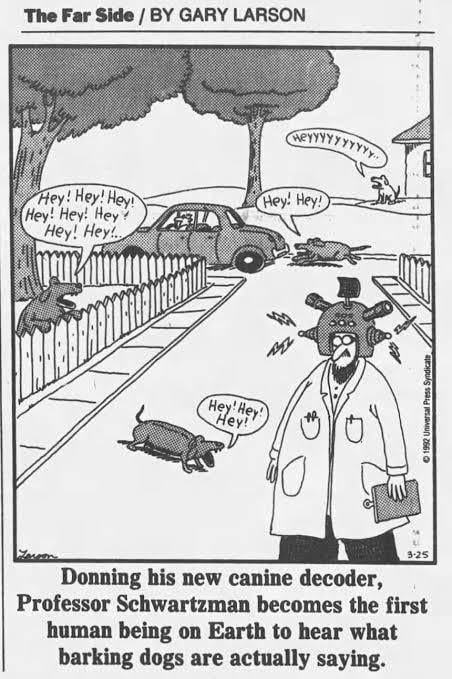
Right? And we have that tendency to want to privilege the language piece in relationships where it seems available, and I think what you’re saying is that it’s often important to kind of push past that, especially in situations where it’s kind of tenuous, like with babies, like with the elderly, where there’s other forms of communication that may actually be more useful or more important.
***
DZ Kalman (outro)
Thanks for listening to the show. Please rate and review it to help us grow. This episode was edited by M. Louis Gordon, and the production manager is Misha Holleb. Belief in the Future is produced in partnership with the Faith Family Technology Network and is a production of Sinai and Synapses. Funding for Belief in the Future comes from the Templeton World Charity Foundation.
If you’re looking for a transcript of the show, you can find one at my blog, gelmanora.com. That’s all for today. See you next time.