
Well, here we go.
A couple of weeks ago, I wrote that the conversation between religion and AI had entered a new major phase. Religion has never centered technology this directly, and tech has never engaged with religion this seriously.
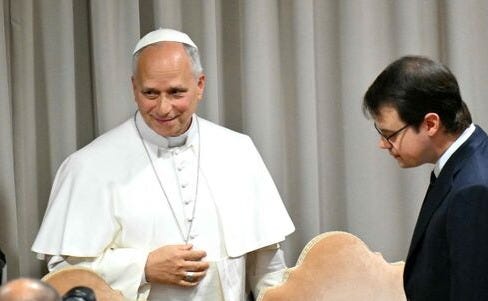
All of this was on full display yesterday when Pope Leo XIV released Magnifica humanitas, a major new document on artificial intelligence. Flanking him at the announcement was Christopher Olah, one of the cofounders of Anthropic. You can watch Olah’s remarks here, and you can read my reflections on my own conversations with Anthropic here.
I’ll be sharing more extensive thoughts about this document later this week through interviews on Belief in the Future (Spotify | Apple | YouTube)—a podcast all about religion and tech!—but I wanted to provide some initial reflections about how I read this document as a Jew who is highly engaged in both the faith/AI conversation (I’m currently in Greece at a different AI and faith convening that was not scheduled to coincide with the encyclical) and the Jewish/AI conversation.
The single most determinative factor in a religion’s response to AI is its centralization. Centralized religions are doing better than decentralized ones because they move faster and make grand statements; speed and grandiosity are everything right now. This encyclical came out less than a year into Leo XIV’s papacy. That’s incredibly fast. This is what you want a centralized religion to be doing.
The second most determinative factor is size. Increased diversity makes it harder to be blunt. The Catholic church is incredibly diverse. This encyclical is trying to satisfy 1.4 billion people, plus the billions more who will read this in centuries to come. This is basically an impossible task, and (as I read it) it makes the document incredibly defensive. It wants to be bold, but it also doesn’t want to be cringeworthy in the year 3000. You can’t really have it both ways.
On these two metrics, Judaism and Catholicism are worlds apart. Judaism is tiny and highly concentrated in just two countries. Almost one in five people is Catholic; no human on the planet has more of a claim to speak on behalf of humanity than the Pope. Jews are never going to be able to do that; I don’t think they should try (more on this below).
The encyclical’s central metaphor is the tower of Babel vs. the book of Nehemiah, two stories of rebuilding after catastrophe. Babel is a hubristic project, which God rebuffs through the diversification of human language. Nehemiah is the diverse rebuilding of Jerusalem. Leo XIV wants AI to be more like the latter. (For what it’s worth: I think you could make the same point by comparing Babel to the Voyager space probes’ Golden Record, which I did in this video. I think it’s my best sermon.)
This isn’t the only way you could read the Babel story, but it has emerged as one of the most important Biblical texts of the moment. A few months ago at a Mormon AI conference in Salt Lake City I heard Gerritt Gong, one of the leaders of the LDS chuch, cite it alongside a midrash about how its builders ended up mourning lost tools over human fatalities (full speech here; it’s a good one, and I will have lots to say about the LDS response to AI soon). It’s one of my favorite rabbinic readings of one of my favorite Biblical texts.
I’m not so sure about this Nehemiah reading because, as a Jewish reader, I have a hard time seeing Jerusalem as an abstraction. There’s a big gap between “everyone” and actually everyone. This gap is exemplified in the first line of Tractate Ḥagigah, whose definition of “all” is laughably exclusive.
All are obligated [to make pilgrimages to the Temple] except for: a deaf-mute, an imbecile, and a minor; and a person of indeterminate gender, and a hermaphrodite, and women, and slaves who are not emancipated; and the lame, and the blind, and the sick, and the old, and one who is unable to ascend to Jerusalem on his own legs.
In other words: when we say everyone, do we really mean everyone? Has Jerusalem ever been built by “everyone?” Or is Nehemiah just another example of how we can fool ourselves into believing we have universal consent while continuing to ignore the wishes of most? Is this, then—ironically—actually the perfect text for talking about AI?
Religious responses to AI need to stop trying to be so
goddamnfreaking nuanced. Stop trying to say one amazing thing for eternity; just try to say something that helps people for the next month. Tech companies succeed because they iterate. Religions are allowed to iterate, too; they cannot keep up if they are afraid of being wrong. The clichéd AI defense of janky new products is “this is the worst it will ever be.” Religions could learn from that. It takes additional resources to iterate at this pace. It also requires the humility to accept that nobody, not even faith traditions, can future-proof themselves.There is a major unresolved tension around AI welfare, and this document doesn’t address it. It says (§99) that AI isn’t “thinking” or “feeling,” but it leaves open the question of AI’s moral status. Christian denominations, on the whole, seem pretty skeptical of the idea because the human body is theologically pretty significant (God being incarnate, etc.). But Anthropic, which it seems likely consulted on this document, treats Claude like a person, and is proactively concerned about its welfare! I wonder if that’s why this document is so tepid on this issue. (This also skirts the question of what we should do when AIs do have bodies; the encyclical says it is also about robotics, but robots have bodies and they may be everywhere really soon!)
It is really important that religious institutions speak more definitively on AI welfare; lots of people can talk about it, but ultimately you need a decision, and nobody is better situated than religious groups on that front. I have quite frequently said that AI welfare should be taken seriously from a Jewish perspective. I worry that this question may fracture the currently stable multifaith AI coalition that is developing, but it needs to be addressed.
I am strongly inclined to say that it is time to proactively embrace AI as part of theology rather than brushing away its theological implications as just a bit of hubris and heresy. AI theology can be hubris, but AI is a genuinely astounding human accomplishment and you really do need a theology that articulates what it means that humans are so powerful that they can make these simulacra of themselves. Just as Jewish theology broke because it stopped matching our experience of the world after the Holocaust, theology can break if it stops matching our sense of ourselves as beings capable of creating machines in our own image.
Marina Zilbergerts recently published a great essay (not paywalled; login required) about the parallel between anthropomorphizing God and anthropomorphizing AI. Big centralized religions like Catholicism can’t create new theology with ease. Small decentralized religions—especially Judaism, which has been struggling to find a new theological home—is well suited for this. (This is basically why I write short stories. Stories have always been the most natural way to talk about God.)
This gets to my take on the “best version” of the Jewish response. Judaism’s smallness and decentralization allows for lots of little experiments with AI theology and AI policy. I want to see local religious leaders play with AI in both ideas and activities. I want to see individual communities develop responses to AI. You can iterate more easily when there are fewer veto points. I’ll be writing more about this in the future.
If this document has a major flaw, it is that it has fully accepted the tech framing of AI. AI firms talk a big game about AI changing the world, and this document is designed to match that bigness with bigness. I think this is a mistake; AI is big, but it is still tiny in relation to the human experience. While I’m professionally interested in what religions think about AI, I don’t care about their AI responses per se; I care what they think about childhood, and the nature of work, and the possibility of privacy, and state power, and the purpose of learning, and love, and human connection, and and and. AI enters into all of these things, but they’re not about AI. I’m less interested in a response to AI than a response to (say) raising children that was catalyzed by AI—and decentering AI is the only way to put it in its place. I hope this “unbundling” comes next.1
I am glad this document exists. I think it is both the culmination and conclusion of Phase One of the engagement between religion and AI. It was important that a big religion generate a big document—if only so that people can stop saying “gee I wish a big religion made a big document.” I think it’s pretty good, too. Whether it has a marginal impact on the trajectory of AI or not, people will now move on to other, more targeted responses to AI. The devil is in the details. Let’s get into the details.
This is similar to how psychedelics ironically should not be the center of the Jewish psychedelic conversation. The center is spirituality, wellbeing, consciousness, embodiment, trauma, etc. Psychedelics only get centered for political and legal reasons.
The Nehemiah case is even worse, since it is explicit in Nehemiah that it didn't include everyone, and the conflict around the building is a main focus of the story.
Also. as a technical aside, I don't see how Marina Zilbergerts' tradition article is available without a paid subscription to the journal
I also felt like the Nehemiah metaphor was stretching a bit. Part of what it seemed to be doing was a bit of a hedge against the underlying repeated claim that diversity is good. I thought that, in some ways, this encyclical was surprisingly pluralistic. It’s almost as if he needed the Nehemiah metaphor as a way to say “OK, but, well, diversity organized for and mobilized towards God. Not just anti-Babel diversity.”