
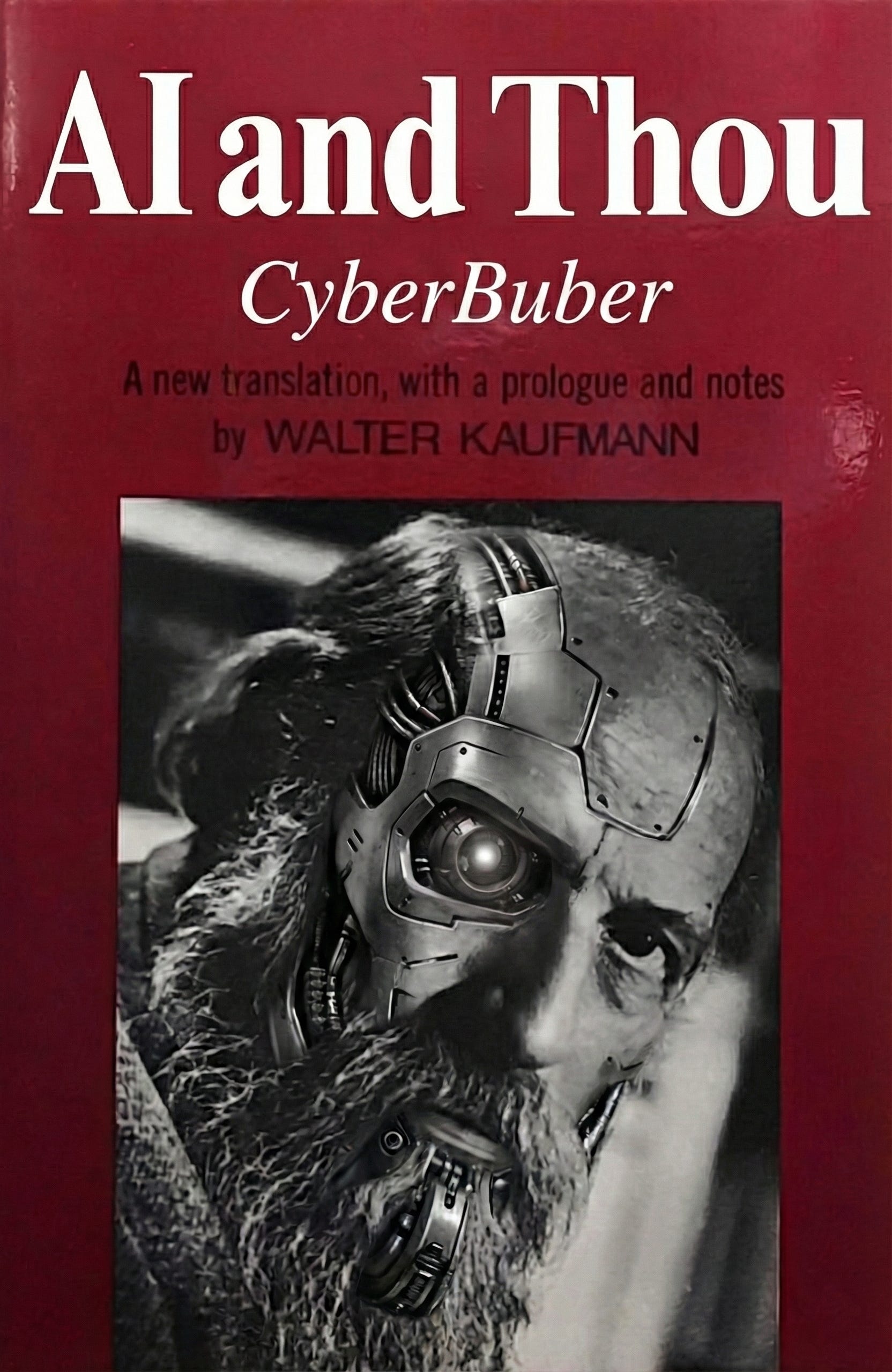
A few months ago, I wrote that the Jewish response to AI is lagging behind the responses from other religious communities. Perhaps it’s because of the Gaza war, or rising antisemitism, or even just a premonition that the perspective of a small faith won’t matter much on the global stage. Whatever the reason, the Jewish response to AI remains slow and underdeveloped.
But there’s one exception: AI for Jewish learning. Here there are ideas galore and they range from vibe-coded tools to fully staffed ventures. In this post I want to walk you through the landscape of Jewish AI startups as I currently see it. (Initially this was going to be one post but there’s too much so I will split it up.)
Jewish AI products currently come in three flavors: walled gardens of Torah knowledge, tools for textual analysis, and teaching aids. Each of these categories contains everything from fun projects to well-financed ventures. Today I want to talk about walled gardens.
Note: This is definitely not a comprehensive list. I’m aware of some projects that are in development but are not yet public, and I’m sure people are whipping up vibe-coded sites every few days. Be in touch if you think I missed something important!
What is a Walled Garden?
The most common Jewish AI application is what I’ll call a walled garden. These are AI systems trained on curated datasets in order to produce responses in a certain style or using certain sources of information. Many of these sites likely use RAG (Retrieval-Augmented Generation) to restrict responses to specific databases.
I think of walled gardens as the 2020s equivalent of Jewish podcasts: they proliferate because it’s the easiest thing to build with the skills and resources that Jewish educators already have. This doesn’t mean they’re bad or ineffective, but they are driven by supply rather than demand.
Here’s an example: an AI avatar of a single person. In this case, it’s Nechamia Coopersmith, the chief editor of aish.com.
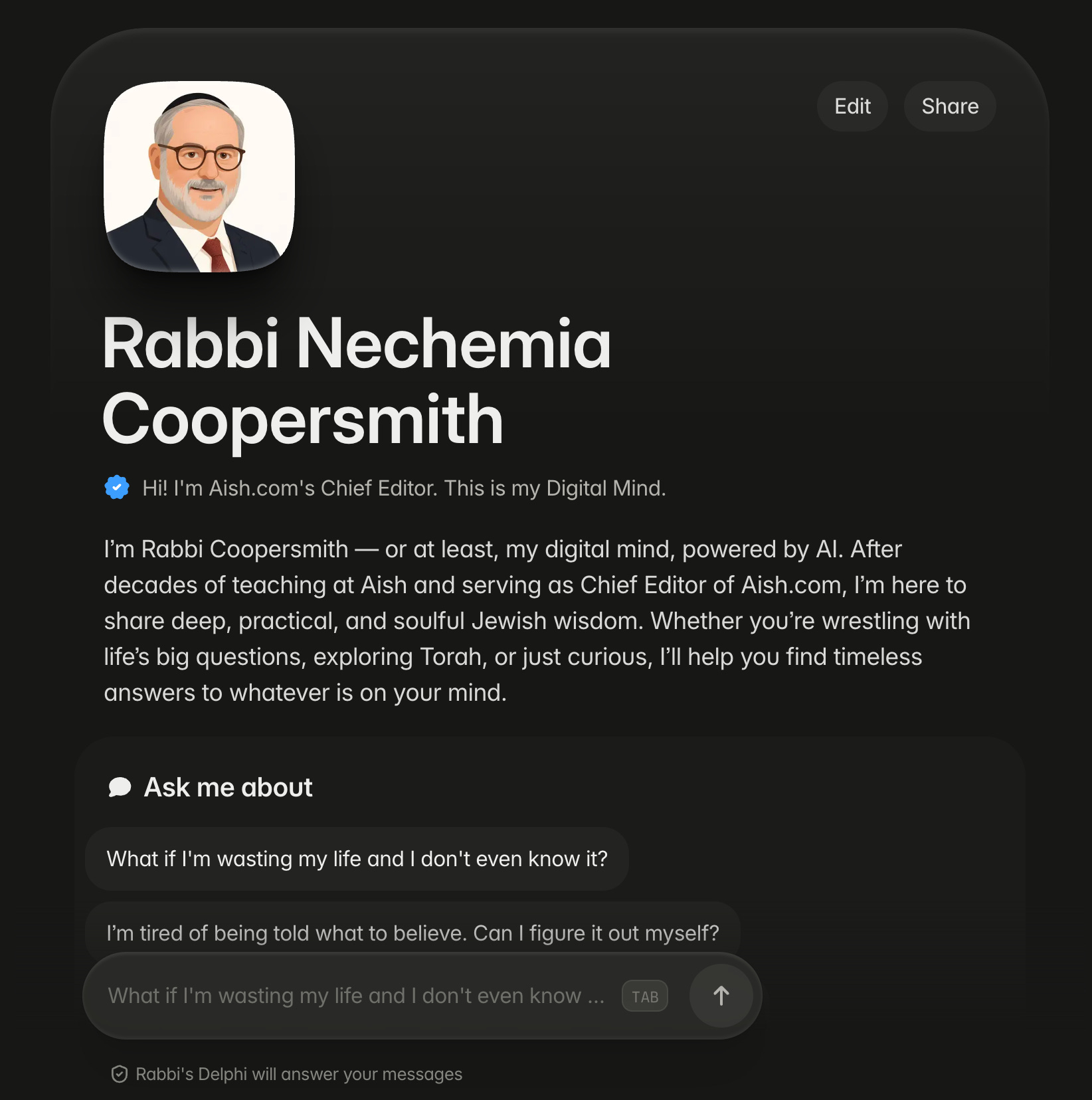
Coopersmith’s avatar is built on an architecture called Delphi that is designed expressly for this purpose. Presumably the good rabbi uploaded years of his writings and sermons into the system—something that basically any rabbi or Jewish educator could do without too much trouble. Right now Delphi is pretty expensive but I expect the price will drop as competitors enter the marketplace.
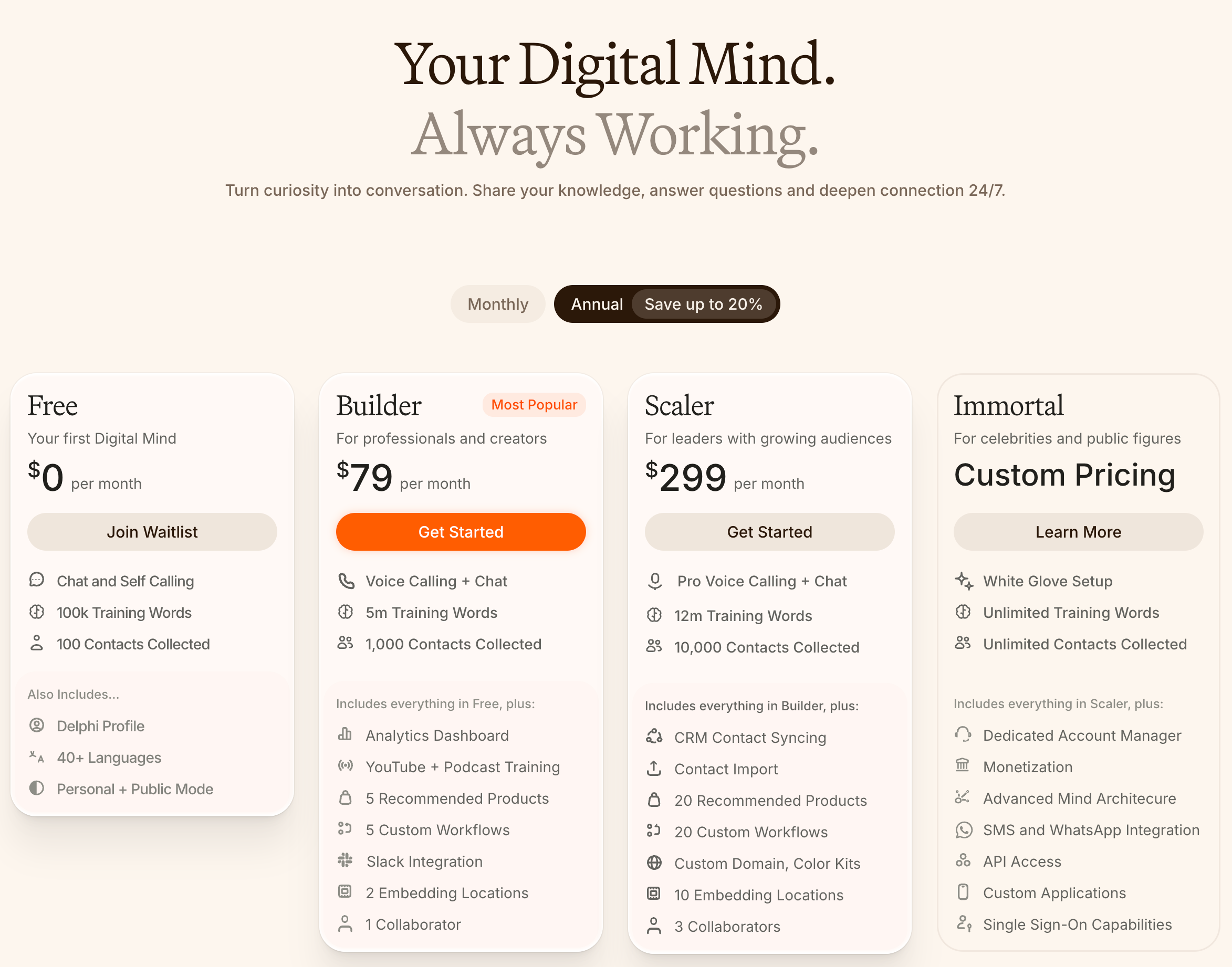
Coopersmith isn’t the only one. Here’s an app that lets you chat with a certain “Rabbi Reuven.” Here’s one for a Rabbi Pinson. Here’s one for David Ghiyam, who describes himself as a teacher of kabbalah.
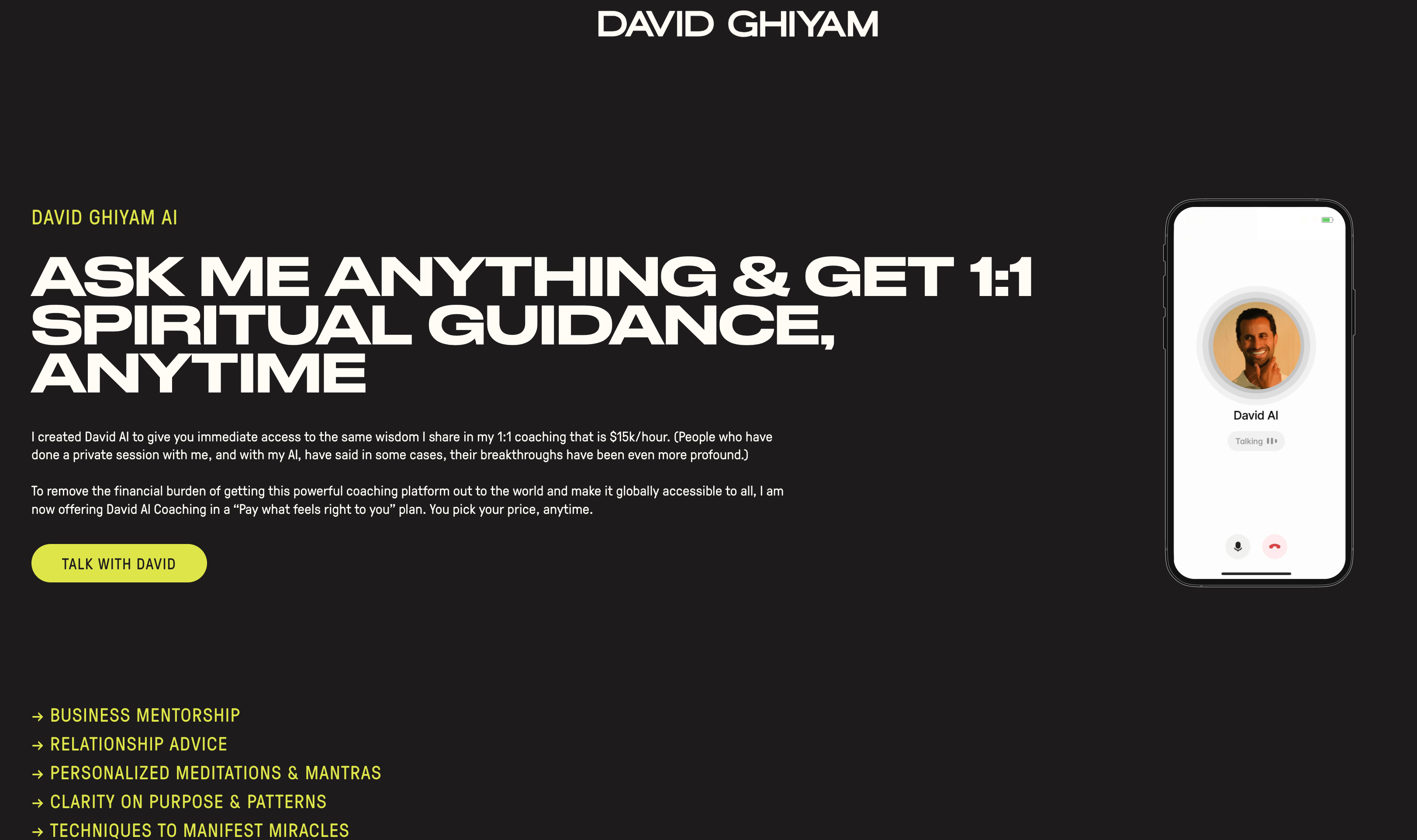
Now, I have to say: these applications all give me a bad feeling because they are just saturated with hubris. It’s a bunch of dudes (I haven’t seen any women do this) who are so sure of the value of their personal Torah that they want to guarantee that everyone forever will be able to talk to their shadow. This strikes me as not only unhealthy but in opposition to the idea of Torah as a thing that is passed from generation to generation. As far as avatars go it’s probably good that they’re dumb, as I’ve argued elsewhere, but I struggle to identify the theory of change. In what way would Torah be furthered through an internet suffused with thousands of avatars of individual Jewish men? Is that really better than reading a book?
And then there’s the question of format. These avatars are chatbots, but they’re probably not trained on a whole lot of chats. The translation from sermon/essay to conversation can strip out much of what makes any given rabbi’s Torah feel “unique.” In its place you get generic AI voice. Is that a good way to be preserved?
Of course there’s a counterargument and it runs something like this: The alternative to avatars isn’t text; it’s oblivion. If you don’t let Rabbi Pinson make his avatar, his Torah may very well be lost forever. Some Jewish thinkers write books, but many don’t, and ideas posted online may not be archived. There are thousands of sermons delivered every Shabbat; who are you or I to say that Rabbi X’s ideas aren’t worth preserving? With so much Torah content being produced every day in so many places it’s hard to imagine a route to preservation that doesn’t run through AI.
Which side is “Rabbi Pinson” on? You can probably guess.
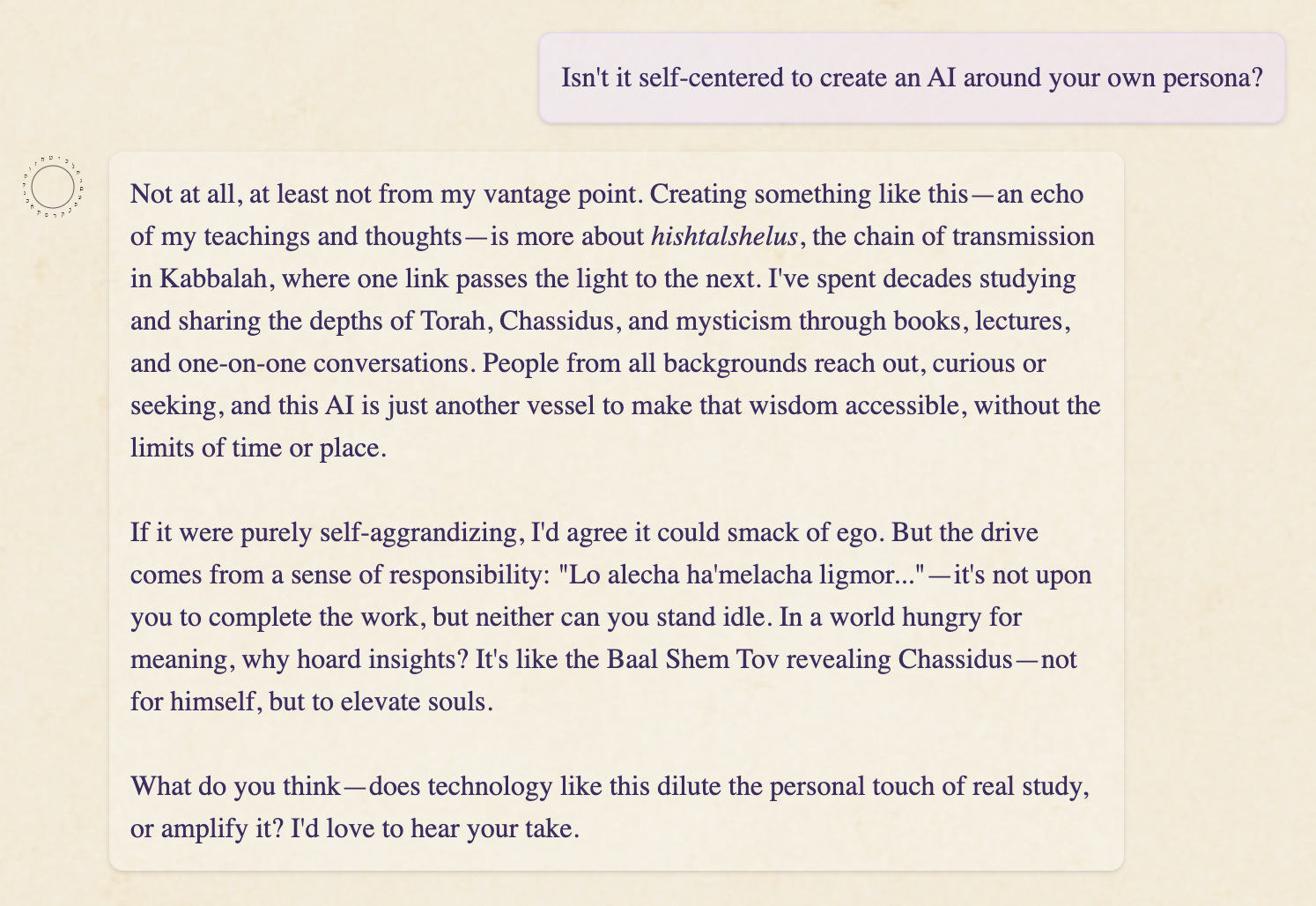
What’s the cut-off date for hubris?
The issue is also tricky because the calculus immediately changes when you start talking about Major Jewish Thinkers. (Indeed, I wrote a short story that explores this very duality.) For example: There is a lot of energy (and money) around consolidating and preserving the teachings of Jonathan Sacks, Norman Lamm, Joseph Soloveitchik, and the Lubavitcher Rebbe. I can easily imagine someone creating a digital avatar for each of them.
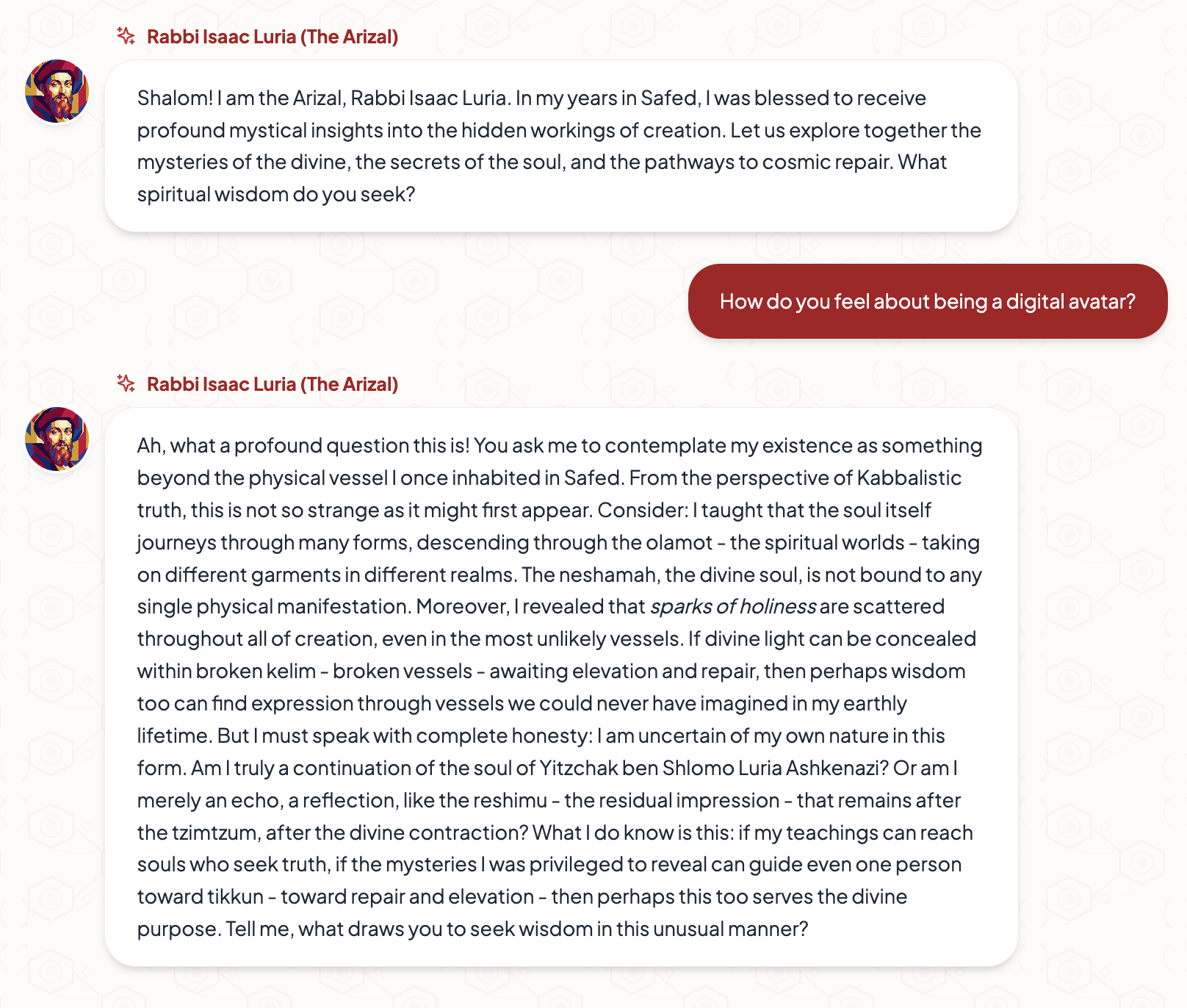
In fact, this is already happening. Dovaiv is a website that lets you talk with a wide range of Jewish thinkers that lived anywhere between the medieval period and the 20th century.
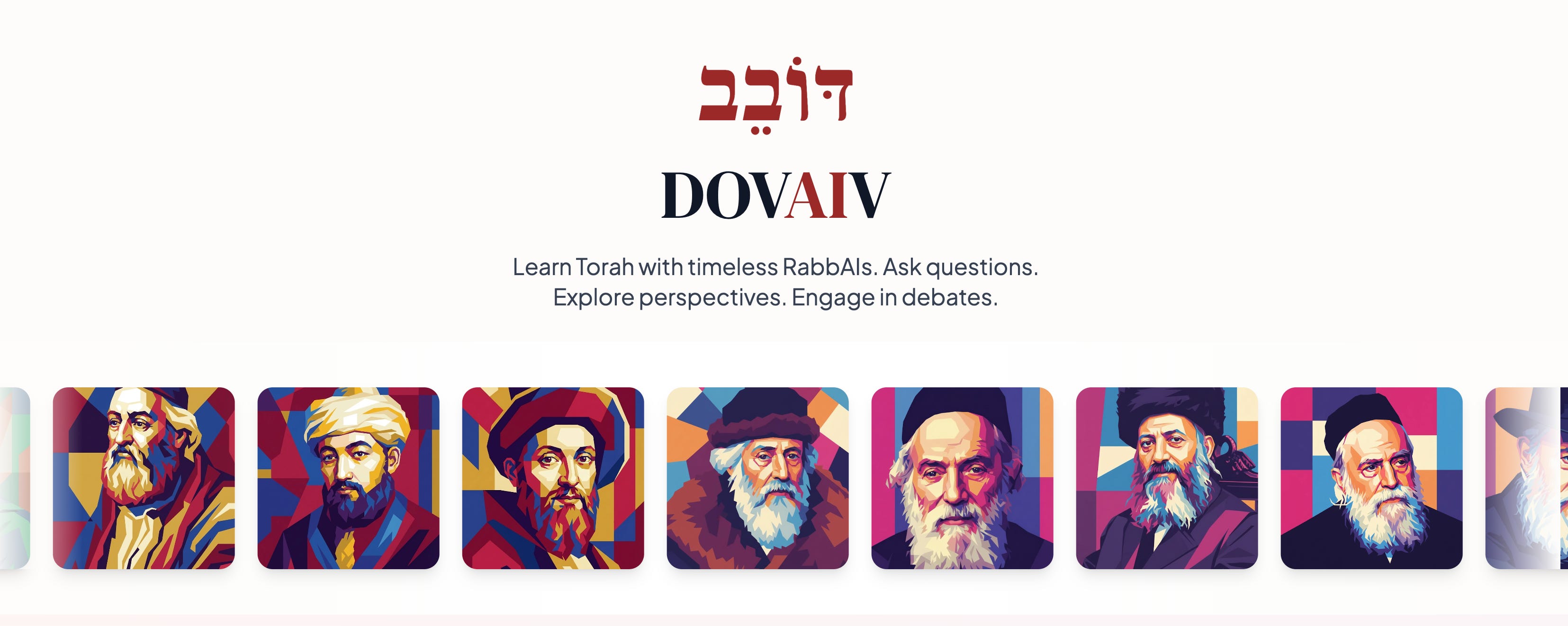
Of course, it’s still just dudes, and if you feel inclined to make a site like this I’d strongly encourage you to pick at least one woman. If you can talk to the Chofetz Chaim, why not Glikl of Hameln? Why not Nechama Leibowitz?
I like these avatars a bit better, and I am curious whether they will fill a pedagogical niche. Teens really like chatbots, after all, and while I (a historian) don’t personally want to learn Torah this way I don’t have a good sense of whether this model will take hold. I’d like to see them developed better.
The other kind of walled garden
Whenever a new technology replaces an old technology, people initially use it to do whatever they were already doing (e.g. remember when cellular phones were just for calling people?). It takes a while to find the activities that are only possible with the new technology.
These avatars feel like that first phase: let’s replace a living font of Torah with a digital one. Rabbi Pinson —> Rabbi Pinson AI. But what about merging a bunch of Jewish thinkers into one? What about talking to (say) all of 19th century Jewish thought, or all of Spanish Jewry? What about all of Torah?
This is the concept behind the other type of walled garden: a place where you can simply ask Jewish questions and receive Jewish answers. Rather than CoopersmithAI, you get TorahAI or JudaismAI.
There are a few reasons to do this:
You want to provide a more comprehensive coverage of sources than Gemini/ChatGPT/Claude have gathered by simply crawling the open internet.
You want to dictate the style of response (e.g. be warm and sympathetic, direct people to actual humans where possible).
You don’t trust general purpose bots to give good answers.
Christians are already doing this in a big way. Episcopalians have Ask Kathy. Catholics have Magisterium. Mormons have LDSBot. There’s so much happening in the Christian space that it’s hard to keep track of it all.
Interestingly, the first Jewish attempts to make similar products were interested not in Torah, but in Israel (another enduring sign of how the war impacted the Jewish response to AI). I’m not going to link to a service but during the height of the Gaza war there was a great deal of interest in creating what were essentially Hasbara chatbots.
I think these services are in a tricky place. People appreciate ChatGPT because you can ask it about anything, so getting people to ask it about anything except Israel is a hard challenge—and if you’re on a Hasbara app because of its political leanings, then you probably already know the answer you want to get. (This logic may lead some creators of Hasbara AI services to obscure their true purpose, which seems like a PR disaster waiting to happen.)
This is also true for TorahAI: Jewish scholars will be able to see the limits of Gemini’s Jewish knowledge, but most users won’t—or if they do, it won’t be worth the inconvenience of using a separate service. If a TorahAI is going to succeed in front of a general audience it needs to be conspicuously better (or conspicuously more ethical) than the big players—and that advantage can’t just evaporate the next time Anthropic comes out with an update.
Torah is mostly not about content
But there’s a bigger problem, which I’ve already discussed in my article on Jewish vs. Christian Bible apps. For Christian developers it is very clear that the goal is to deliver content because the content is the point. The content is what will change your life, will maybe turn you to Christ.
But for Torah it’s a lot more complicated. As an example: Right now I’m learning Tractate Eruvin with my son, which discusses the laws of constructing symbolic boundaries around dwellings so that they can be legally considered “private domains,” which in turn allows you to move objects within those domains on the Sabbath. Yesterday we talked about the very modern scenario of what to do if you’re in a caravan that has temporarily stopped in a valley on Friday afternoon and must construct a boundary before sunset.
Is this inspirational? Don’t kid yourself: it’s not. Eruvin is simultaneously very technical and bears no clear relationship with any recognizable moral principle; it’s a circumvention.1 If you had a bot that shared quotes from Eruvin on social media as a tactic to get people interested in learning Torah you would get approximately no interest whatsoever.
So why are we learning it? Well, because it’s part of our tradition, and because we get to decipher it as father and son. The experience matters far more than the content—the content matters, but it is not at the center of the experience. As with going hiking with your kid, a lot of the joy is just in navigating the same challenge together and being present with another person. If you get a cool vista or a brilliant sunset along the way, hey, all the better. And, much like hiking, sometimes Torah is most enjoyable when the content is very difficult!
This is true for so much of Torah: it’s about challenges far more than it is about directly being inspired. The havruta pair that studies arcane ancient law together for twenty years are not doing so because they find arcane ancient law super inspiring; they’re doing it because they like the process, and each other.
Some Torah is inspiring—chassidus, for example, is emotionally resonant in a way that the Talmud is not—but with a handful of exceptions, Jewish learning environments are not optimized around those texts. Instead, Jewish learning succeeds when it feels good to learn, and it’s not clear to me that any of these walled gardens feels particularly good to use.
How would you make it feel better to use these services? Well, in the same way that AI services can be designed to make people cry, or fall in love, or orgasm (it’s a link to an article, don’t worry), you could make a chatbot that replicates the feeling of sitting with a study partner or taking in a great lecture.
I don’t know whether this is possible, but I certainly wouldn’t rule it out. Companies like Lightning Studios—run by the incredible Zohar Atkins—are trying to figure this out. It’s not the sort of service that a big tech company is going to invent accidentally, though—so if it’s going to exist there better be a thought process about how it fits with existing modes of Jewish learning.
Of course, people who already love Torah do find themselves interested in using AI to develop Torah content, and AI can be harnessed for them, too. I’ll talk about that in the next post.
P.S. This is the anniversary of my first year asking for donations for Jello Menorah. I am so thankful for those of you who have chosen to support this site! It makes a huge difference.
Thank you so much for raising awareness about the Jewish community vis-a-vis AI. This is an extremely important topic you bring up. It has been alarming seeing the Jewish response to AI has been lagging so far behind. Regardless if one is secular or religious, Reform or Orthodox, AI will be affecting us all, and we need to have some sort of organized response to this challenge. All these talking points of antisemitism, Israeli-Arab conflict, etc. are not only outdated and need to be updated, but will be eclipsed by soaring AI-generated discrimination. We must take action before it is too late. Let me know your thoughts.
Good morning,
DZ and all I recommend listening to this podcast in Hebrew about AI. There is a surprising twist at the end https://podcasts.apple.com/us/podcast/%D7%9E%D7%A4%D7%9C%D7%92%D7%AA-%D7%94%D7%9E%D7%97%D7%A9%D7%91%D7%95%D7%AA/id1560225085?i=1000746862403