
In my first post this year on AI and Jewish learning, I noted that many people have built Torah chatbots that are basically specialized versions of ChatGPT / Claude / Gemini, and that it’s unclear whether these have a real purpose. In the second post, I made the case that Jewish learning as a whole should lean into its love of process.
For this post, I decided to feature a project of my own design—one that I could build because of AI, but is not itself an AI product. This past weekend, I took a handheld gaming device and repurposed it to run a modified version of Sefaria.
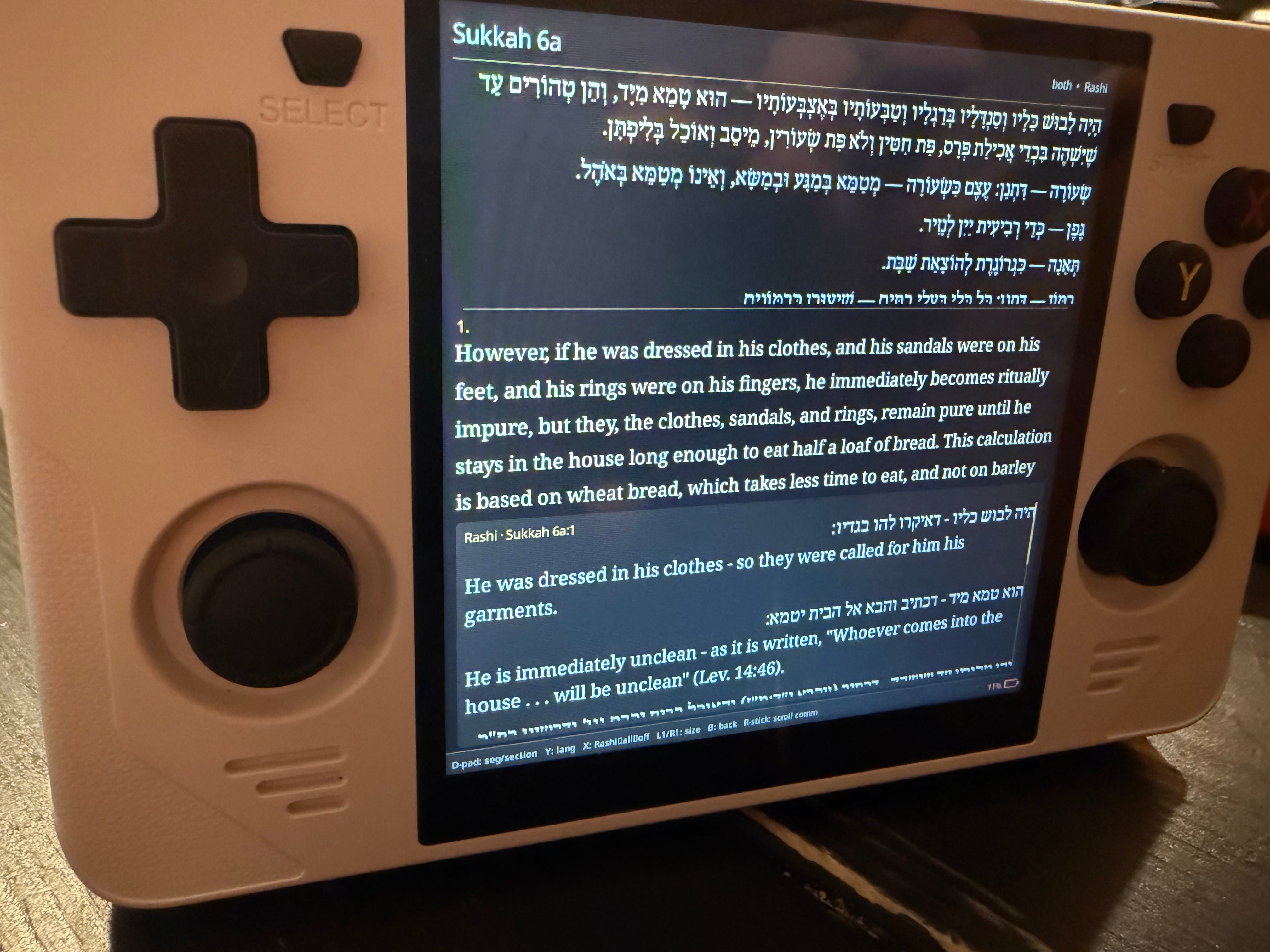
It’s not glamorous, but it is surprisingly functional. The D-pad lets you scroll through chapters. A is the selection button, B is the back button. Y cycles you though Hebrew only / English only / bilingual modes. X pulls up the commentary on a verse (currently just Rashi). L1 and R1 change the text size.
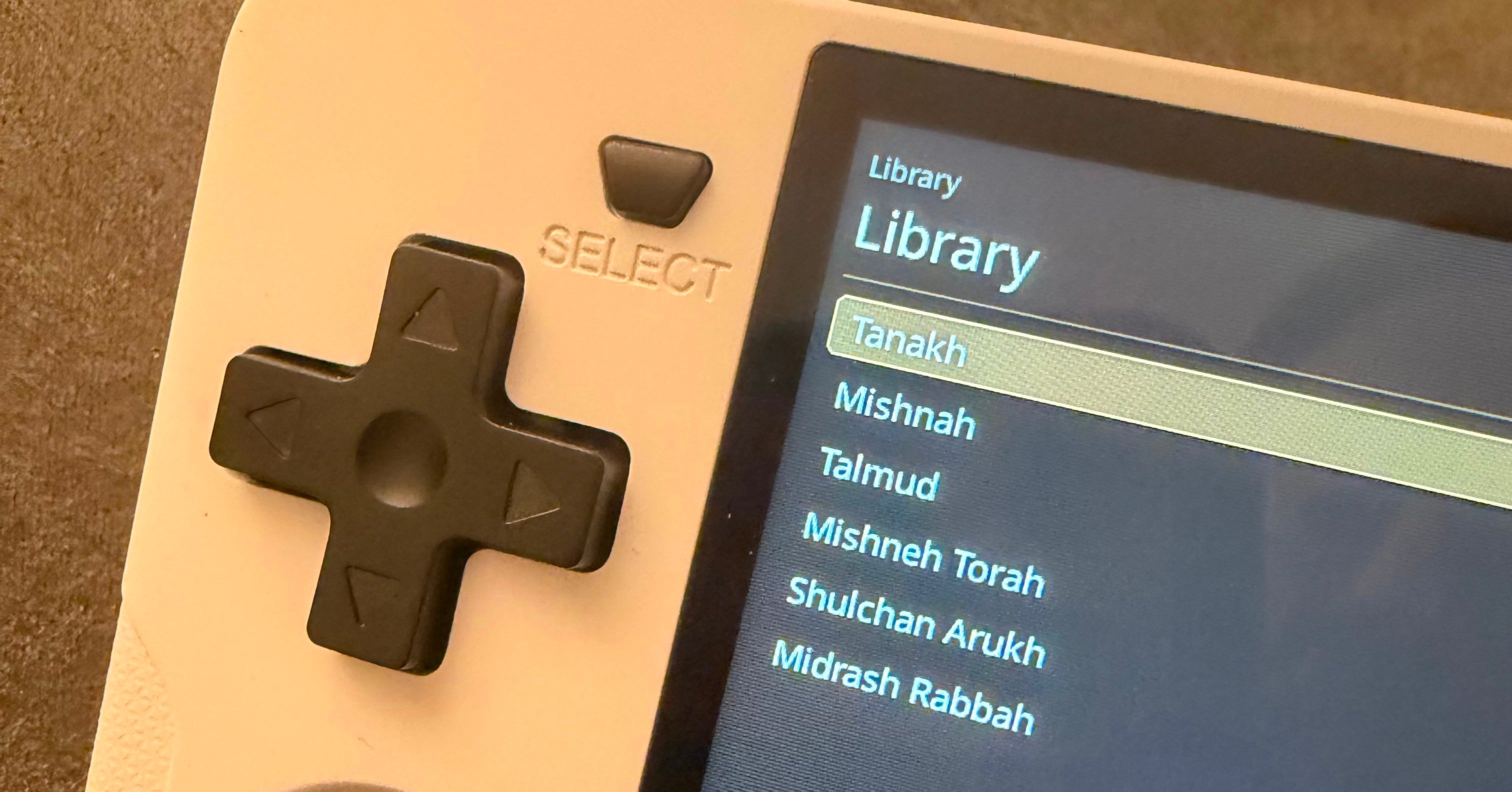
I call it TorahOS. Here’s what you see when you boot it up:
And here’s a representative screen. It’s in bilingual mode and Rashi’s commentary is pulled up at the bottom:
Why did I build this? Keep reading.
Digital Torah is a miracle but it’s a bummer to use
As I have written before, Jewish learning is about experience and not just content. Part of that experience has, traditionally, meant paging through actual books, pulling books off the shelf, writing notes in the margins, etc.
Now, of course, almost all written Torah is available online. This is tremendously helpful for accessibility, but it means that Torah no longer comes in its own packaging. Instead, a site like Sefaria becomes just one more tab in your browser, or just one more app on your phone. You lose the feeling of being inside a beit midrash, even when the apps contain more material than all but the most well-equipped study halls. (It’s also hard to focus when the same devices contain so much else that is competing for your attention.)
One solution is to go back to books. For digital Torah is indispensable for research, but for casual learning—and for learning with kids—I strongly prefer physical books. The physicality matters more than the speed of knowledge acquisition.
But another solution is to take control of the form factor. Accessing Torah is not a computationally complex task; you don’t need anything nearly as sophisticated as an iPhone or MacBook to run it. You could design a standalone piece of Torah hardware that is used for no other purpose. This would allow you to preserve the scope and accessibility of digital Jewish learning while (a) physically separating it from other digital services and (b) providing a new way to physically shape the culture of learning.
Ultimately, a device like this could be built from the ground up—but the first step is to see whether you can create a dedicated Torah device using existing hardware.
Retro gaming consoles were clearly the strongest test candidates. These are devices that usually resemble a Gameboy or Nintendo DS but are far more powerful. Typically they come preloaded with thousands of old games, but at the end of the day these handhelds are really just tiny Linux machines. All you need to do is swap the preloaded microSD with a microSD of your own software.
What I tried
Now, I had developed this idea a couple of years ago but got stuck on the execution. Because Sefaria makes so much digital Torah available freely, a lot of the needed databases already exist; everything you need to make an offline Torah database is on Github. The hardest thing would simply be to create a user interface that did not require a keyboard and was legible on a small screen.
None of the developers I talked to thought this was a hard problem, but it still takes real work. Because I am not a coder myself, the project stalled; I liked the idea but it didn’t feel important enough to justify the time.
And that’s where Claude Code came in. I asked it which retro gaming handheld had the highest chance of success and then, after ordering the device, set Claude to work creating the bespoke software. It took a few hours to develop and then another few hours to install, but within the space of a weekend I was able to take a basic gaming console and get it to run a selection of Torah sources. The process was basically painless. I even got Claude to upload its code to a repo.
Please steal this idea
I offer TorahOS as a proof of concept that I want you to steal. The idea of a handheld Torah device is my own—it occurred to me while I was was building a Retropie arcade cabinet—but you should definitely take it and run with it. I don’t plan on developing TorahOS much further; I just want people to know it’s possible and inspire them to carry it forward.
Some thoughts about what you might do with it next. Consider these my challenges to the reader:
How would you make TorahOS better? What other features should it have?
What’s the cheapest form factor that would support digital Torah? The device I used cost $100, but I bet you could get by on something much less powerful.
Could you build TorahOS into a shtender? Or some other ritual object? Could you built it into a smart mirror? Some entirely new form factor?
Is this just art? What form factor would make you want to use one of these devices on a regular basis? What would it need to be able to do?
How do you implement search on a device with only a few buttons? Is it worth implementing at all?
And if you do end up making your own device or develop an associated tool, let me know!
Good evening
I would like to find out if there is a bot that can teach me haftorah tropes. Are you aware of anything available out there?
Did you share this with Sefaria? https://developers.sefaria.org/docs/powered-by-sefaria